





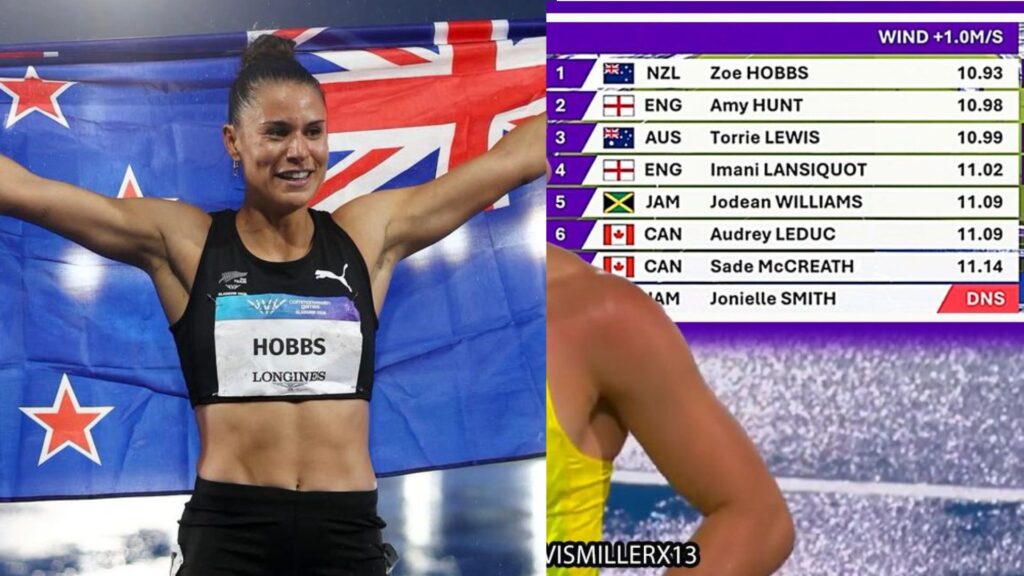
New Zealand’s Zoe Hobbs produced the sprint performance of her career to win the women’s 100m title at the Commonwealth Games 2026, storming to gold in a sensational 10.93 seconds and rewriting the Oceania record books in Glasgow.
The 28-year-old Auckland sprinter clocked 10.93 (+1.0 m/s) to break her own New Zealand and Oceania records, pulling clear in the closing metres to defeat England’s Amy Hunt, who claimed silver in 10.98, while Australia’s Torrie Lewis took bronze in a national record 10.99.
Remarkably, all three medallists dipped below the 11-second barrier, making it the first time in Commonwealth Games history that every athlete on the women’s 100m podium has broken 11 seconds.
The race was decided by the finest of margins, with just 0.06 seconds separating gold from bronze.
Women’s 100m Final
 Zoe Hobbs (New Zealand) – 10.93 (Oceania & New Zealand Record)
- Amy Hunt (England) – 10.98
- Torrie Lewis (Australia) – 10.99 (Australian Record)
 Zoe Hobbs (New Zealand) – 10.93 (Oceania & New Zealand Record)
 Amy Hunt (England) – 10.98
 Torrie Lewis (Australia) – 10.99 (Australian Record)
Despite wet conditions that made the Glasgow track slick underfoot, the trio delivered one of the fastest and deepest women’s 100m finals in Commonwealth Games history.
For Hobbs, the victory marked the crowning moment of an outstanding championship. Draped in the New Zealand flag after crossing the finish line, she celebrated not only a Commonwealth title but also another improvement to the Oceania record she already owned.
Hunt Continues Her Rise
England’s Amy Hunt enjoyed a memorable Commonwealth Games debut, finishing just five hundredths of a second behind Hobbs.
Her 10.98-second performance was the second-fastest 100m of her career, underlining her continued rise among the world’s elite sprinters. The silver medal also rewarded her consistency throughout the championship after progressing confidently through the earlier rounds.
Lewis Breaks Australian Record
Australia’s Torrie Lewis capped a remarkable championship by lowering the Australian national record to 10.99 seconds to secure bronze.
Lewis had already announced her form in the semifinals with an 11.00-second national record before finding another hundredth of a second in the final to become the first Australian woman to break the 11-second barrier at the Commonwealth Games.
The Glasgow final will be remembered as one of the greatest women’s sprints in Commonwealth Games history—a race where records tumbled, history was made, and three athletes simultaneously broke one of sprinting’s most iconic barriers