




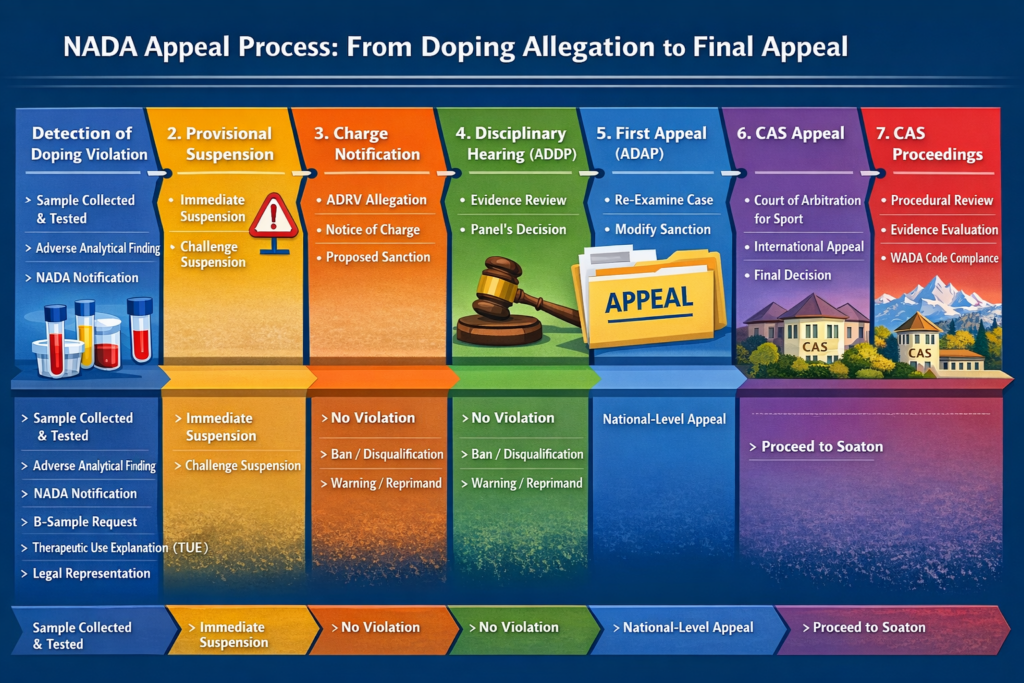
1. Detection of Doping Violation (Initial Stage)
The process begins under Results Management (WADA framework):
• Athlete sample collected (urine/blood)
• Tested in a WADA-accredited lab
• If an Adverse Analytical Finding (AAF) → violation suspected
The athlete is formally notified by NADA:
• Right to request B-sample analysis
• Right to explanation (Therapeutic Use Exemption – TUE)
• Right to legal representation
2. Provisional Suspension (Optional but Common)
• In serious cases (e.g., steroids), provisional suspension is imposed immediately
• Athlete can challenge the suspension
3. Results Management & Charge Notification
NADA formally asserts an Anti-Doping Rule Violation (ADRV) such as:
• Presence of a banned substance
• Refusal to test
• Whereabouts failure
The athlete receives:
• Notice of charge
• Proposed consequences (ban, disqualification, etc.)
4. Hearing Before Disciplinary Panel (ADDP)
Case goes to:
Anti-Doping Disciplinary Panel (ADDP)
• Independent judicial body
• Conducts hearings if the athlete does not waive rights
• Reviews:
o Lab evidence
o Athlete’s defense
o Intent, negligence, contamination claims
Panel issues the first decision (sanction)
Possible Outcomes:
• No violation
• Warning / reprimand
• Ban (2–4 years or more)
• Disqualification of results
5. First Appeal: Anti-Doping Appeal Panel (ADAP)
If dissatisfied, the athlete (or NADA/WADA) can appeal to:
Anti-Doping Appeal Panel (ADAP)
Timeline:
• Appeal must be filed within 21 days of the ADDP decision
What ADAP Does:
• Re-examines:
o Evidence
o Legal arguments
o Sanction proportionality
• Can:
o Uphold decision
o Reduce/increase sanction
o Overturn decision
This is the final national-level appeal
6. International Appeal: Court of Arbitration for Sport (CAS)
After ADAP, the final appeal lies with the Court of Arbitration for Sport (CAS)
Who can appeal?
• Athlete
• NADA
• International Federation
• WADA
• IOC / IPC
Special Cases:
• International-level athletes can sometimes:
o Appeal directly to CAS (bypassing ADAP)
7. CAS Proceedings (Final Stage)
• Independent global tribunal (Lausanne, Switzerland)
• Reviews:
o Procedural fairness
o Evidence integrity
o Application of the WADA Code
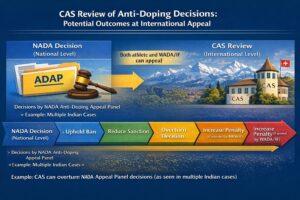
Outcomes:
• Uphold ban
• Reduce sanction
• Overturn decision
• Increase penalty (if appealed by WADA/IF)
Example: CAS can overturn NADA Appeal Panel decisions (as seen in multiple Indian cases)
Example of Decision Overturned
1) Inderjeet Singh (Shot Put)
Inderjeet Singh tested positive in 2016.
The shot putter appealed, alleging ‘sabotage’. The arguments were mainly based on procedural lapses in collection, chain of custody, transportation of samples, testing, etc.
• The ADDP rejected all such arguments and handed down a four-year sanction
• He later approached ADAP, claiming supplement contamination
He was cleared by ADAP, which accepted his argument in a landmark ruling on 14 December 2018.
However, in October 2019, the Court of Arbitration for Sport overturned the clean chit given to Inderjeet Singh and upheld a four-year doping ban.
Sequence:
Tested positive in 2016
ADDP imposed a four-year ban
Cleared by ADAP citing contamination
Returned to competition
World Anti-Doping Agency appealed to CAS
CAS overturned the ADAP decision
Recent Case: Ramesh Nagapuri (Coach)
The Anti-Doping Appeal Panel lifted the provisional suspension of Ramesh Nagapuri. The suspension was imposed by NADA on June 18 last year.
As per NADA’s document dated December 2, 2024, doping control officials were deployed at the G.M.C. Balayogi Athletics Stadium, Hyderabad, to collect samples from athletes. During the notification process:
• The coach allegedly prevented athletes from signing notification forms
• He instructed athletes to leave the venue, resulting in evasion of testing
• He failed to provide contact details of the athletes under his supervision
One of the athletes involved was Shanmuga Srinivas Nalubothu, the 2024 Indian Open Athletics 200m silver medallist (20.67s), also India’s all-time 7th best time. He was also booked for evasion by NADA.
These actions led authorities to conclude that the coach may have facilitated the evasion of doping control.
Subsequently, NADA initiated proceedings under:
• Article 2.5 – Tampering with doping control
• Article 2.9 – Complicity (assisting or encouraging a violation)
A formal notice was issued on March 17, 2025, and the coach was placed under provisional suspension pending disciplinary proceedings.
PROCEEDINGS
• The coach denied all allegations and challenged the suspension
• His request for revocation was rejected by the ADDP (July 3, 2025)
• He then filed an appeal before the Anti-Doping Appeal Panel
ADAP Proceedings
For Nagapuri’s case, three ADAP members were present:
• Geetanjali Sharma (Chairperson)
• Dr. Rana Chengappa (Medical Member)
• Rani Rampal (Sports Member)
Divergence of Opinion (Split Verdict)
Minority View – Dr. Rana Chengappa
• The coach’s actions—interfering in notification, redirecting athletes, and withholding information—amounted to active assistance in evasion
• Under WADA jurisprudence, such conduct qualifies as complicity (Article 2.9)
The suspension was considered valid and justified
Majority View – Geetanjali Sharma & Rani Rampal
• Athletes are individually responsible for complying with anti-doping rules
• Even if influenced by the coach, the decision to evade testing rests with the athletes
• Anti-doping obligations include a clear duty to cooperate with testing authorities
Thus, the panel found that:
• The coach cannot be solely held accountable at this stage
• The burden of responsibility cannot be shifted entirely away from the athletes
Final Ruling
• The provisional suspension imposed on the coach was revoked until final adjudication
• The matter remains pending before the ADDP for final determination on merits