
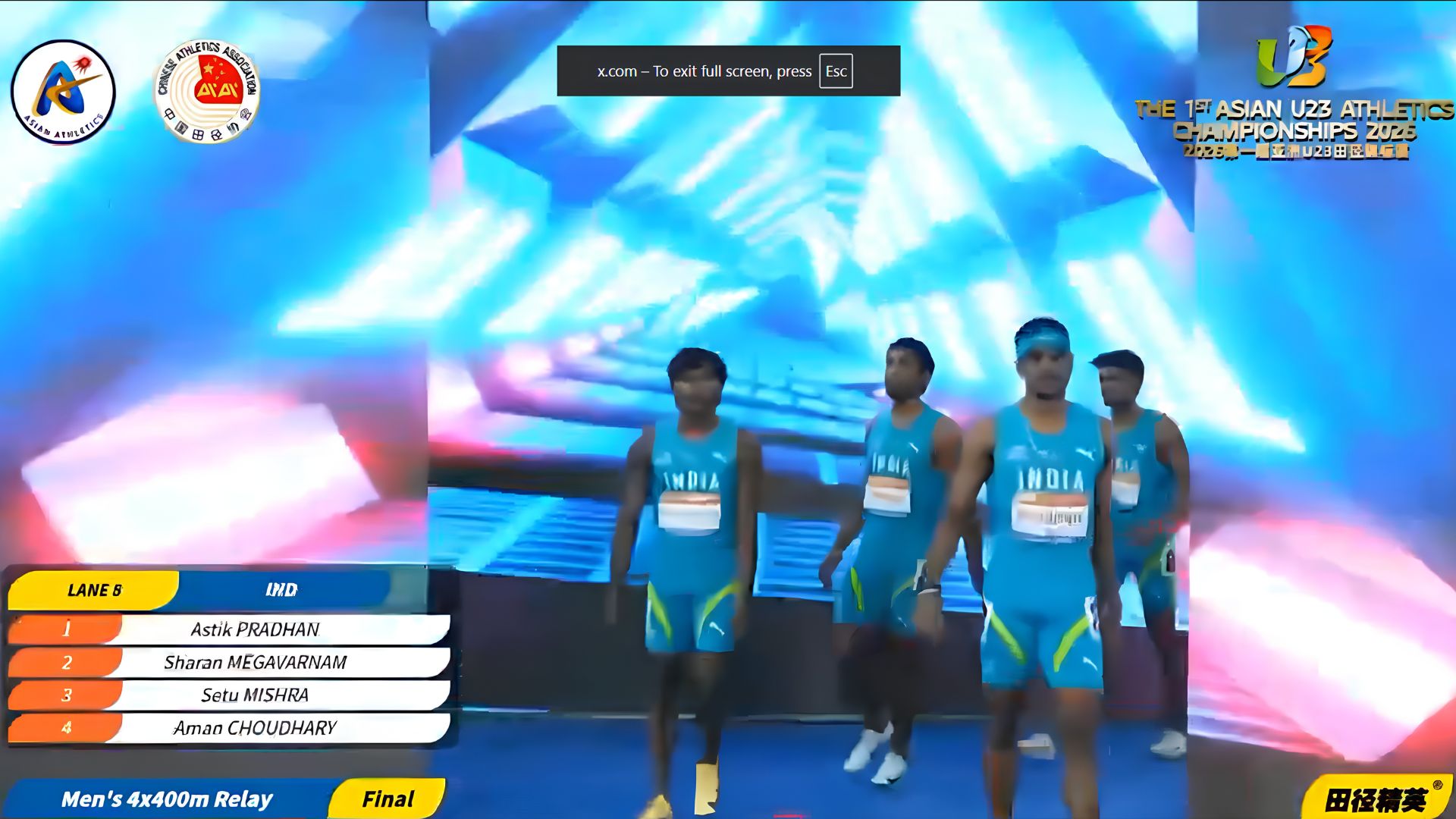
India’s men’s 4x400m relay team delivered a strong performance to secure the silver medal at the 2026 Asian U23 Athletics Championships, finishing in 3:04.24.
The Indian quartet of Astik Pradhan, Megavarnam Sharan, Setu Mishra, and Aman Choudhary fought hard throughout the race but finished behind China, which claimed the gold medal in 3:03.46. Qatar took the bronze medal with a time of 3:06.19.
Astik Pradhan provided India with an excellent start, handing over in the lead after a brilliant opening leg. Megavarnam Sharan maintained the advantage with another composed run before China moved ahead during Setu Mishra’s third leg. On the anchor leg, Aman Choudhary mounted a determined chase but was unable to bridge the gap, ensuring India finished with a well-earned silver medal.
The podium finish adds another medal to India’s impressive campaign at the Asian U23 Athletics Championships, reflecting the country’s growing depth in the 4x400m relay.
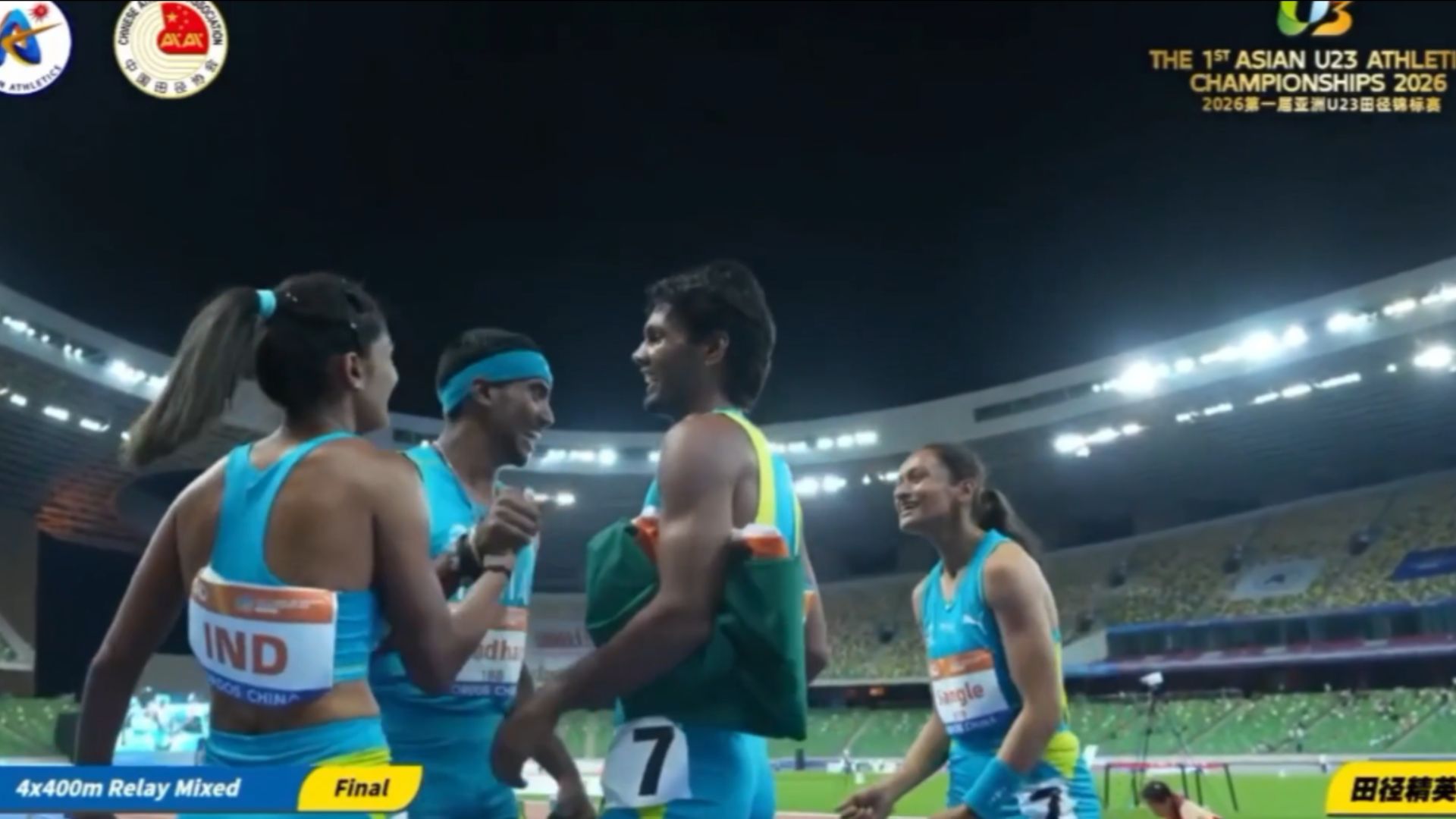
India celebrated a landmark moment at the inaugural Asian U23 Athletics Championships in Ordos, China, as the Mixed 4x400m Relay team won the country’s first-ever gold medal at the competition with a thrilling victory over hosts China.
The Indian quartet of Astik Pradhan, Sandramol Sabu, Setu Mishra, and Shravani Sachin Sangle clocked 3:18.64 to finish atop the podium. China settled for silver in 3:18.74, while the Philippines claimed the bronze medal with 3:25.28.
Each member of the Indian team played a crucial role in the historic triumph, but it was anchor Shravani Sachin Sangle who produced the defining moment of the race. Displaying remarkable speed and composure, she overtook China’s Yingying Huang in the closing stages to secure a dramatic victory for India.
The gold medal marks India’s first title at the debut edition of the Asian U23 Athletics Championships and highlights the country’s growing strength in relay events. The memorable win adds another chapter to an impressive campaign for the young Indian contingent in Ordos.
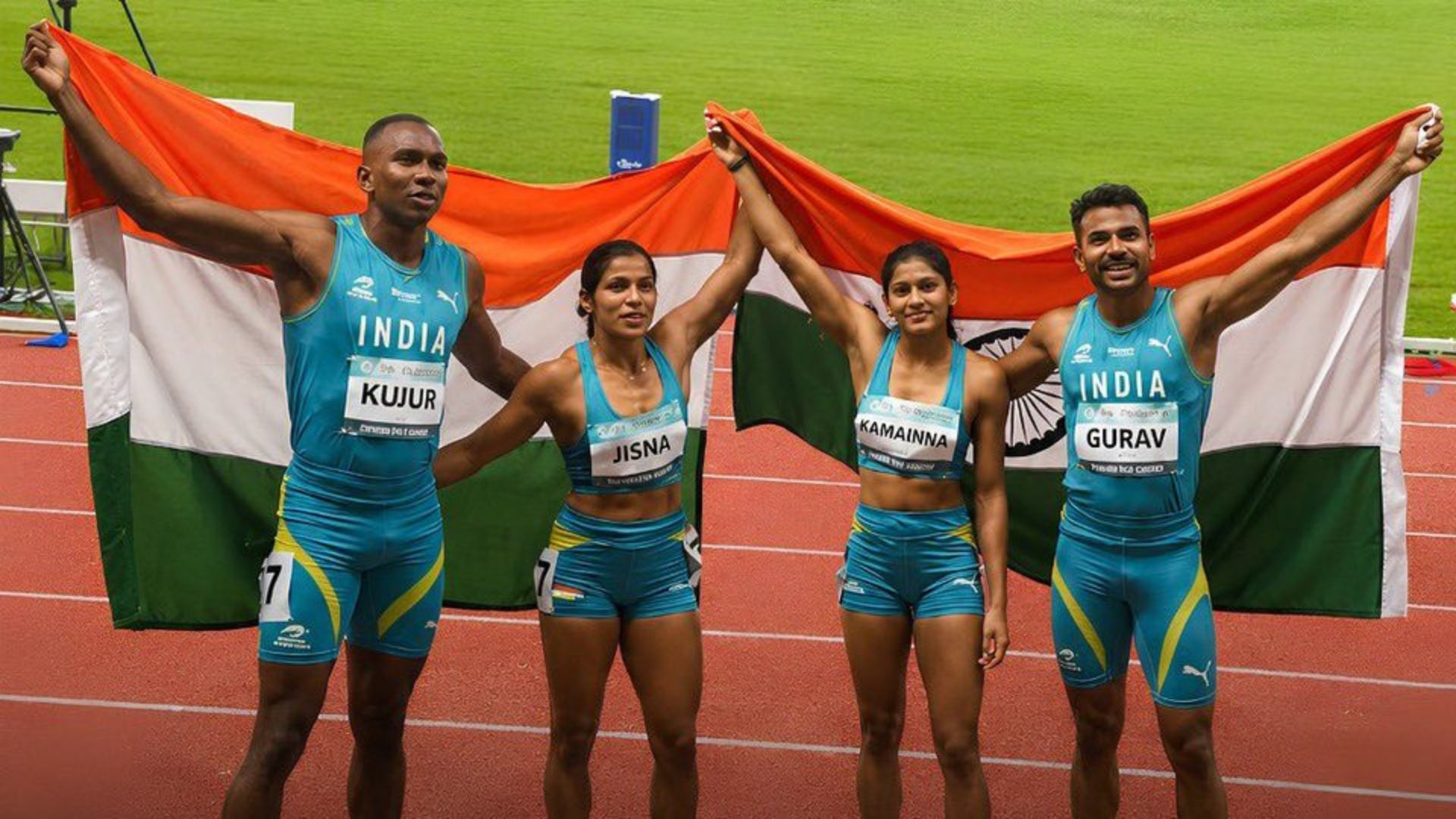
India’s mixed 4x100m relay team secured the bronze medal at the Asian Relays Championships 2026, clocking 41.47 seconds in a closely contested final.
The Indian quartet produced a strong performance throughout the race and looked well placed for an even higher finish before a costly baton exchange on the final changeover allowed their rivals to surge ahead.
Pranav Gurav got India off to a solid start on the opening leg before Tamanna delivered an impressive second leg to keep the team firmly in contention. Animesh Kujur then produced a powerful third-leg run, helping India move into the lead heading into the final exchange.
However, a delayed baton exchange between Animesh and anchor runner Sneha disrupted India’s momentum at a crucial stage of the race. The loss of speed during the handover allowed both Thailand and China to overtake in the closing metres, leaving India to settle for bronze.
Despite the setback, the medal represents another positive result for Indian sprinting and highlights the growing competitiveness of the country’s relay programme at the continental level.
Thailand claimed the gold medal with a winning time of 41.14 seconds, while China finished second in 41.29 seconds. India completed the podium in 41.47 seconds.
Final Results
 Thailand – 41.14s
 China – 41.29s
 India – 41.47s
The result adds another medal to India’s tally at the Asian Relays Championships and provides valuable international competition experience for a relay squad that continues to develop ahead of major championships in the coming years.
For India, the performance will be viewed as both encouraging and frustrating—encouraging because the team showed it had the speed to challenge for gold, and frustrating because a cleaner final exchange may well have resulted in an even higher finish.
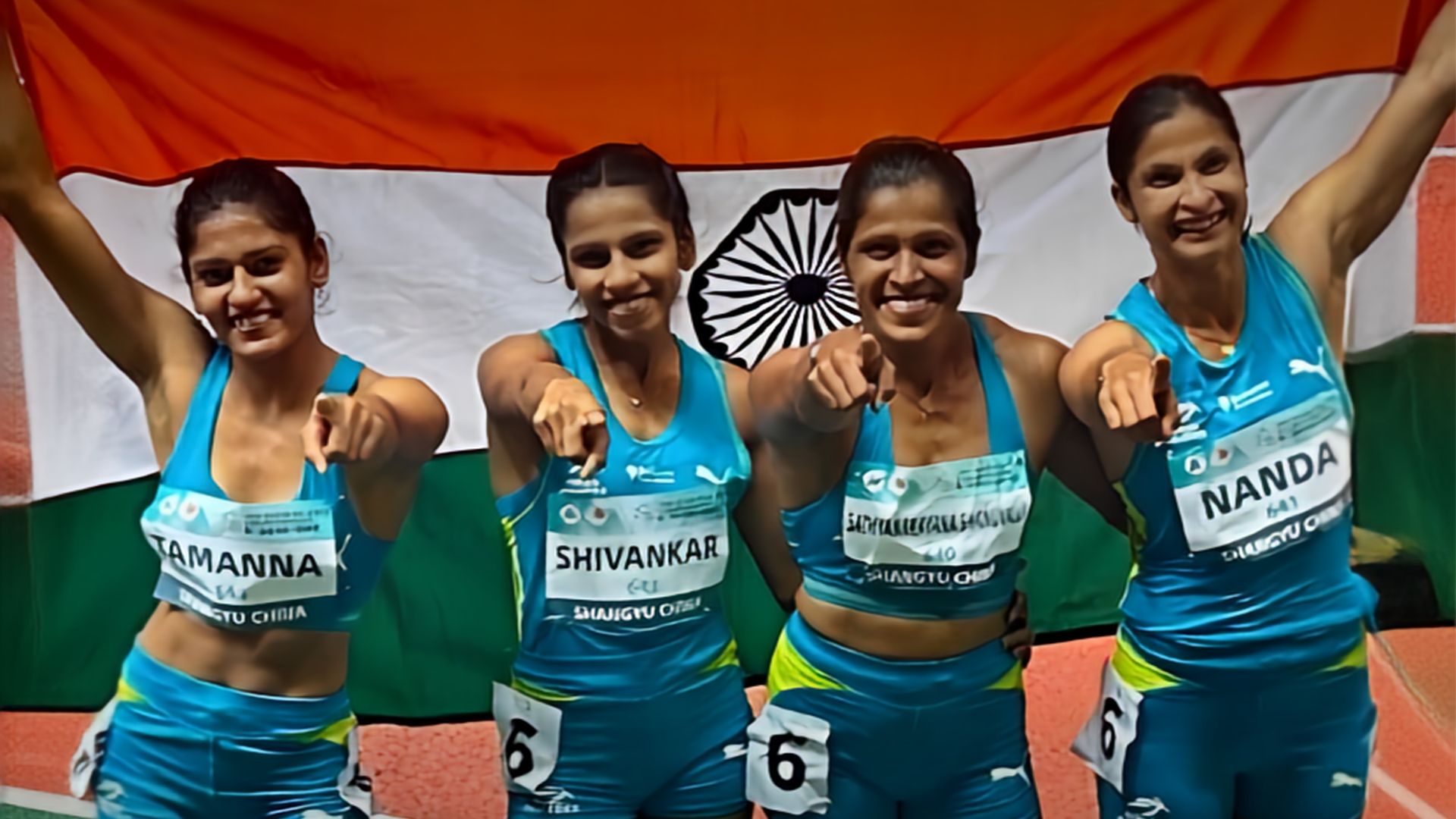
India’s women’s 4x100m relay team produced a superb performance to clinch the gold medal at the Asian Relays 2026, continuing the country’s strong tradition in sprint relays on the continental stage.
The quartet of Srabani Nanda, Sneha S S, Sudheshna Shivankar and Tamanna combined brilliantly to clock a season-best 43.85 seconds, finishing ahead of a strong field to secure the top spot on the podium.
The victory was made even more impressive by the fact that the Indian team ran faster than it did while winning silver at the previous edition of the Asian Relays. Last year, the Indian quartet had finished second with a time of 43.86 seconds, making this year’s gold-medal-winning performance marginally quicker.
China finished second to claim the silver medal in 44.09 seconds, while Thailand took bronze after clocking 44.11 seconds in a closely contested race.
The result is a significant boost for Indian women’s sprinting and highlights the growing depth in the country’s relay programme. The team’s ability to deliver a season-best performance on a major international stage reflects both strong individual form and effective baton exchanges, often the decisive factor in relay racing.
For Srabani Nanda, Sneha S S, Sudheshna Shivankar and Tamanna, the gold medal represents a major achievement and provides valuable momentum ahead of the busy international season, which includes key qualification events and major championships.
By finishing ahead of both China and Thailand, India not only secured the gold medal but also sent out a strong statement about its ambitions in women’s sprint relays on the continental stage.
Bureau Report
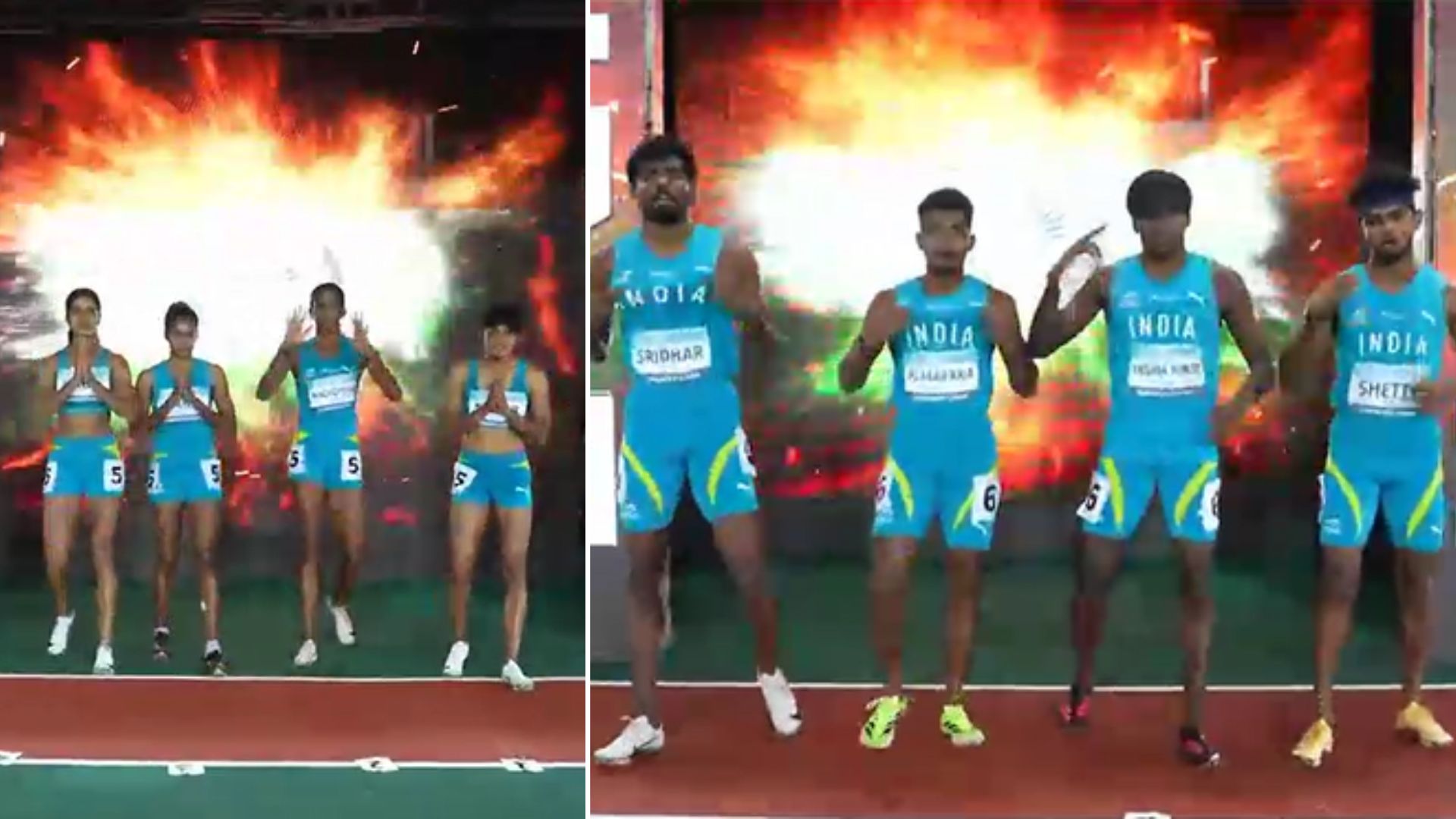
India endured a disappointing campaign at the Asian Relays 2026, with both the men’s and women’s 4x400m relay teams failing to finish on the podium despite entering the competition with high expectations.
The women’s team finished fourth, missing out on a medal as Vietnam clinched gold in 3:31.16. China secured silver with 3:32.68, while Kazakhstan claimed bronze after clocking a personal best of 3:33.87.
The men’s team fared even worse, finishing fifth in a race won by Vietnam, whose quartet produced a personal best of 3:02.60. China took silver in 3:03.23, while Sri Lanka completed the podium with 3:03.33.
The results raise uncomfortable questions for Indian athletics, particularly given the level of support available to the country’s relay programmes.
India’s relay athletes benefit from year-round training at the National Centre of Excellence (NCOE) in Trivandrum, work under foreign coaches and receive extensive support through the Sports Authority of India’s Target Olympic Podium Scheme (TOPS). Yet despite access to infrastructure, coaching and funding that many Asian nations can only aspire to, India failed to secure a medal in either relay event.
Some observers may point out that the men’s team was not India’s strongest possible combination and could be viewed as a second-string squad.
That argument, however, becomes harder to make in the women’s event.
Under the Athletics Federation of India’s current campers-only selection policy, the relay squad was effectively the best available combination from the national camp system. If the athletes selected from the country’s premier training setup were unable to reach the podium at the continental level, it raises larger questions about the effectiveness of the current high-performance structure.
The performances also come at a time when several Asian nations are making significant strides in relay running. Vietnam’s gold medals in both men’s and women’s events underline the rapid progress being made by countries that have traditionally not been considered relay powerhouses.
For India, the Asian Relays were expected to be a stepping stone towards bigger targets such as the Asian Games and Commonwealth Games. Instead, the competition has highlighted the gap that still exists between investment and results.
By Sushant Singh
India’s mixed 4×100m relay team secured a bronze medal at the Asian Relays Championships 2026, finishing with a time of 41.47 seconds.
Pranav provided a solid start, while Tamanna and Animesh kept India in contention, with the team leading heading into the final exchange. However, a delayed baton handover between Animesh and anchor runner Sneha cost valuable time, allowing Thailand and China to move ahead in the closing stages.
Thailand claimed the gold medal in 41.14 seconds, followed by China with 41.29 seconds, while India completed the podium with a bronze-winning effort of 41.47 seconds.
Bureau Report
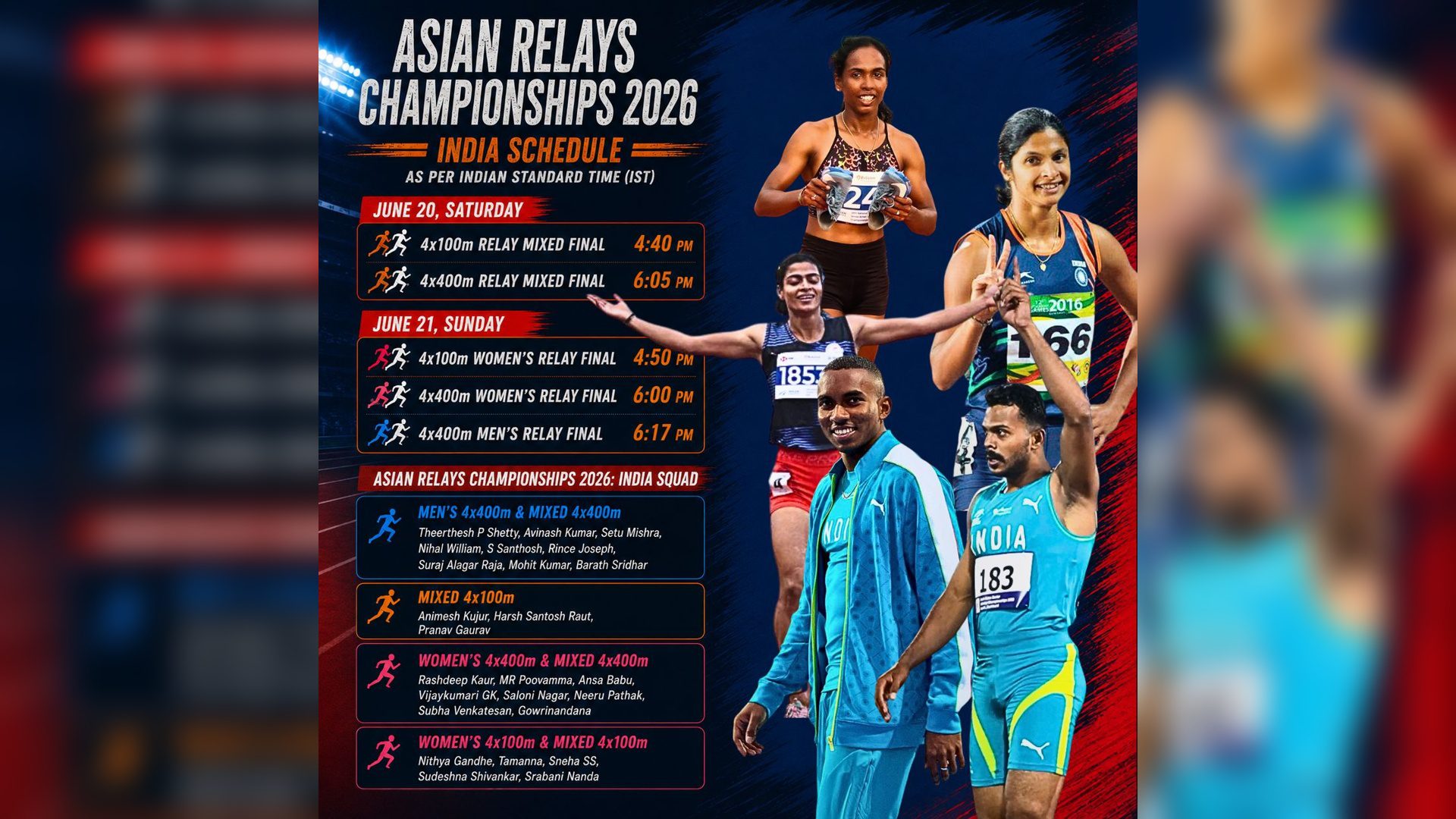
Asian Relays Championships 2026 | June 20–21
After a Federation Cup that produced national records in sprints, pole vault, and high jump, the spotlight now shifts to the track’s most collective discipline — the relay. India’s relay teams are set for action across two days at the Asian Relays Championships 2026, with mixed, men’s, and women’s squads all competing for continental honours.
The Schedule (All Timings IST)
Saturday, June 20
- 4x100m Relay Mixed Final — 4:40 PM
- 4x400m Relay Mixed Final — 6:05 PM
Sunday, June 21
- 4x100m Women’s Relay Final — 4:50 PM
- 4x400m Women’s Relay Final — 6:00 PM
- 4x400m Men’s Relay Final — 6:17 PM
Five finals. Two days. A packed and high-stakes relay calendar for Team India.
The Squads
Men’s 4x400m & Mixed 4x400m
India’s men’s quarter-mile stocks run deep, with eight athletes named across the pool for these events: Theerthesh P Shetty, Avinash Kumar, Setu Mishra, Nihal William, S Santhosh, Rince Joseph, Suraj Alagar Raja, Mohit Kumar, and Barath Sridhar. With this much depth on the roster, India’s selectors have options to fine-tune their strongest possible combination for both the standalone men’s final and the mixed relay.
Mixed 4x100m
A compact trio anchors India’s mixed sprint relay effort: Animesh Kujur, Harsh Santosh Raut, and Pranav Gaurav. Kujur arrives with serious pedigree — having recently broken the national 100m record at Federation Cup with a blistering 10.15s. His sprint speed could prove decisive in what is traditionally one of the most unpredictable relay formats on the circuit.
Women’s 4x400m & Mixed 4x400m
India’s women’s quarter-mile group is stacked with experience and emerging talent: Rashdeep Kaur, MR Poovamma, Ansa Babu, Vijaykumari GK, Saloni Nagar, Neeru Pathak, Subha Venkatesan, and Gowrinandana. The inclusion of MR Poovamma — one of Indian athletics’ most decorated relay campaigners — brings invaluable big-stage experience to a squad otherwise blending fresh faces into the mix.
Women’s 4x100m & Mixed 4x100m
India’s sprint relay hopes rest with Nithya Gandhe, Tamanna, Sneha SS, Sudeshna Shivankar, and Srabani Nanda. Srabani Nanda’s experience at the international level adds composure to a sprint unit that will need slick exchanges to compete with the continent’s fastest nations.
Why the Relays Matter
Relay events carry a unique weight in athletics — they are tests of speed, yes, but also of precision, trust, and team chemistry. A single fumbled baton exchange can undo months of individual training in a fraction of a second. For India, a nation that has produced increasingly competitive individual sprinters and quarter-milers in 2026, the relay events are where that talent must come together as one unit against Asia’s best.
With strong individual performances already on the board this season — national records in the 100m, depth in the 400m, and rising sprint talent across the board — India’s relay squads arrive in good spirits and even better form.
Time to Cheer
Two days. Five finals. Squads built on a blend of seasoned campaigners and hungry newcomers. India’s baton-carriers are ready to take on the continent’s finest.
Get behind Team India as the Asian Relays Championships 2026 gets underway.
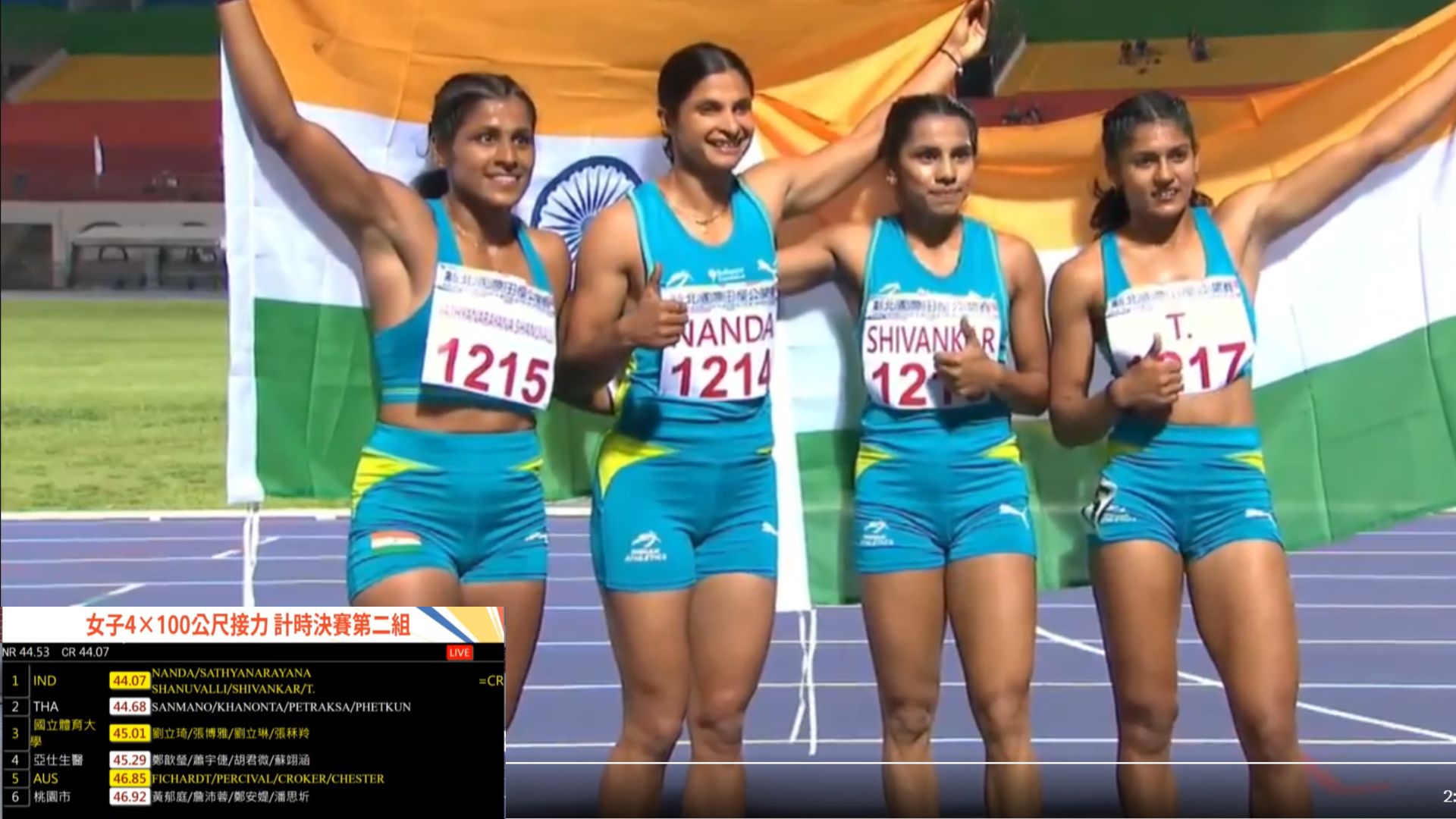
India’s women’s 4x100m relay team delivered another commanding performance on the international stage, clinching gold at the New Taipei City Athletics Open 2026 while equalling the Championship Record of 44.07 seconds.
The quartet of Srabani, Sneha, Sudheshna and Tamanna combined brilliantly to dominate the race from start to finish. Srabani gave India a solid start on the opening leg before Sneha maintained the momentum through the second exchange. Sudheshna then produced a blistering third leg to extend India’s advantage, setting the stage for Tamanna to bring the baton home with a strong anchor leg.
The winning time of 44.07 seconds carried a special significance. Not only did it secure another gold medal for India, but it also matched the Championship Record set by the Indian team at the same competition last year.
Remarkably, India had won gold at the 2025 edition of the New Taipei City Athletics Open in exactly the same time — 44.07 seconds — making this year’s triumph a near-perfect repeat of their success from twelve months ago.
While the result underlined India’s superiority at the meet, the team has already shown that there is even more speed in reserve. Their best performance over the past two years came at the Asian Athletics Championships in 2025, where the quartet clocked an impressive 43.86 seconds, becoming one of the few Asian teams capable of regularly breaking the 44-second barrier.
That benchmark will be firmly in their sights as preparations continue for the Asian Games. In sprint relays, consistency is often as important as outright speed, and India’s women have steadily established themselves as one of the continent’s most reliable relay units.
The performance in New Taipei City offered further evidence of that growing stability. Clean baton exchanges, strong individual legs and a winning mentality helped India comfortably secure another international title while matching the meet record they already owned.
With the Asian Games on the horizon, India’s women’s sprint relay team will be aiming to convert this consistency into even faster times. If they can produce a few more sub-44-second performances in the coming months, they could emerge as genuine medal contenders against Asia’s strongest sprint relay nations.
For now, however, the team can celebrate another gold medal, another Championship Record, and another reminder that Indian women’s sprinting continues to move in the right direction.
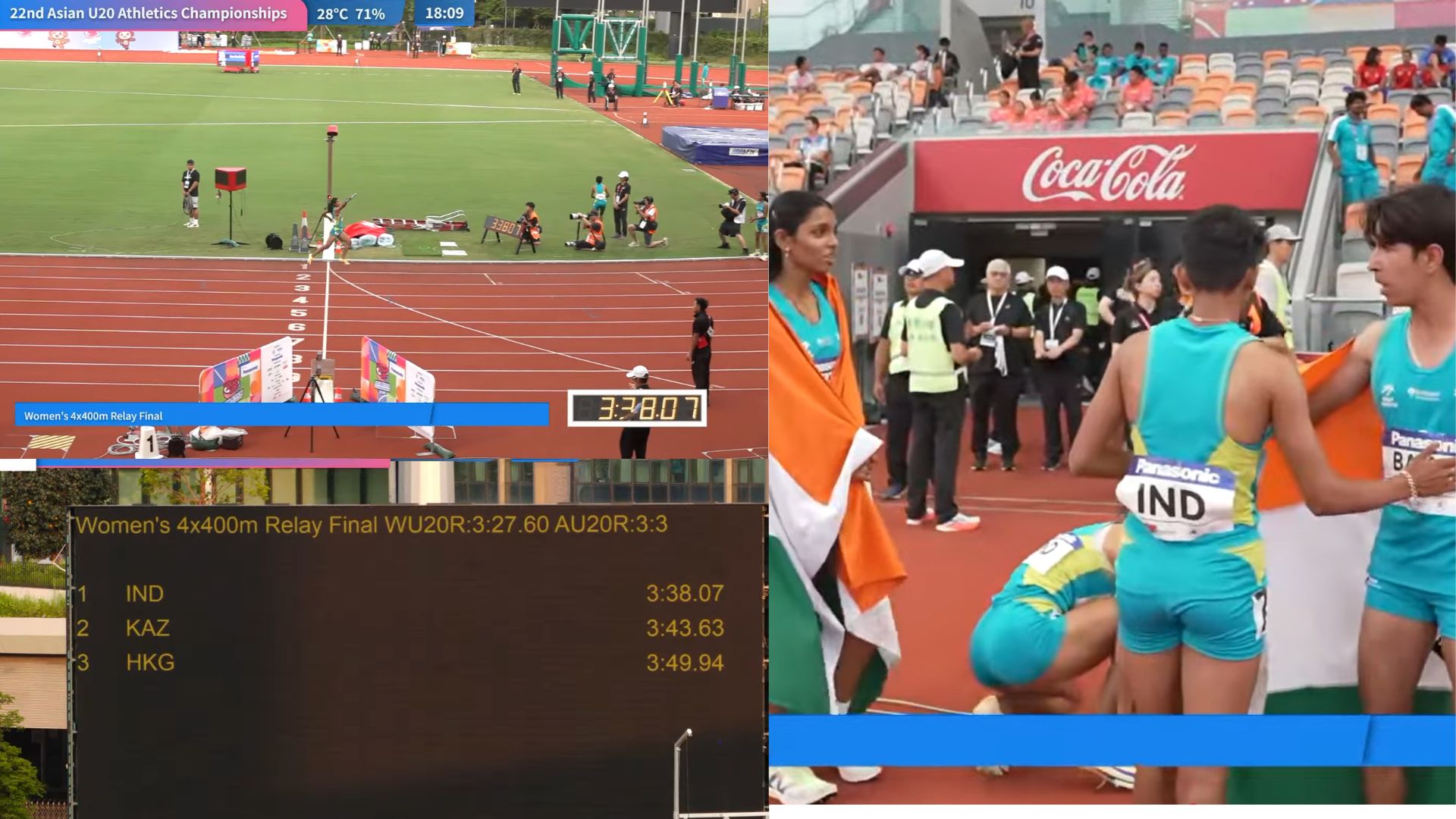
India’s U20 women’s 4x400m relay team delivered a commanding performance to win the gold medal at the U20 Asian Athletics Championships 2026 in Hong Kong, capping off a memorable campaign with a new championship record.
The Indian quartet stormed to victory in a time of 3:38.07, breaking the previous meet record and underlining the country’s growing strength in the one-lap relay event. The performance was one of the standout moments of the championships and added another gold medal to India’s impressive tally in Hong Kong.
From the opening leg, the Indian team established itself among the frontrunners and maintained a strong rhythm throughout the race. Smooth baton exchanges and consistent splits ensured that India remained in control as the race progressed. By the final leg, the team had created a decisive advantage over its rivals, allowing the anchor runner to bring home the gold in record-breaking fashion.
The winning time of 3:38.07 not only secured the top spot on the podium but also erased the previous championship mark, highlighting the exceptional quality of the performance. The result further reinforces India’s reputation as one of Asia’s strongest relay nations at the junior level.
The gold medal was particularly significant given the depth of competition at the championships, with several Asian nations fielding strong relay squads. India’s ability to dominate the race and set a new meet record showcased both the talent and preparation of the young team.
The victory also reflects the steady progress of women’s sprinting and relay events in India. In recent years, Indian relay teams have enjoyed increasing success at continental and global competitions, and the latest triumph suggests that another promising generation is emerging through the junior ranks.
The gold-medal-winning performance played a key role in India’s successful overall campaign at the U20 Asian Athletics Championships, where the country finished second on the medal table with 19 medals.
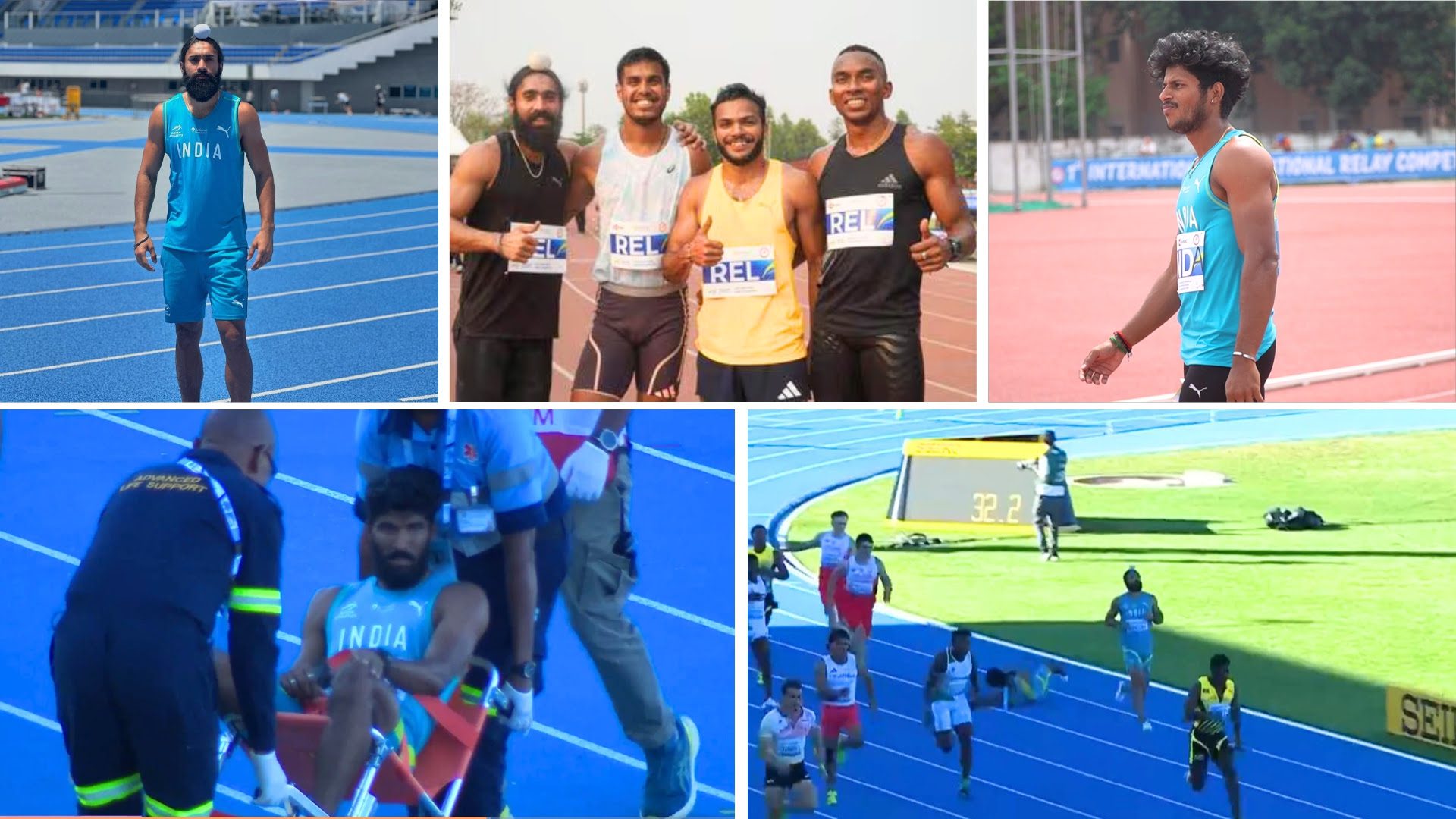
Indian sprinting is experiencing an unprecedented golden era, yet its men’s 4x100m relay dreams are collapsing under the weight of poor planning, technical failures, and internal friction.
The renaissance began in October 2023 when Army sprinter Manikanta Hoblidhar clocked 10.23s, shattering Amiya Mallick’s seven-year-old national record. By 2025, Indian sprinting reached a historic peak. Gurindervir Singh lowered the national record to 10.20s, only for Animesh Kujur to obliterate it three months later with a current national record of 10.18s. In 2025 alone, five Indian sprinters combined for a staggering nine sub-10.30s performances:
10.18s – Animesh Kujur
10.19s – Manikanta Hoblidhar
10.20s – Gurindervir Singh
10.22s – Tamilarasu
10.27s – Pranav Gurav
This explosive depth ignited hope for a competitive men’s 4x100m relay squad. In April 2025, that dream looked tangible when the Reliance-backed quartet of Animesh, Manikanta, Gurindervir, and Amlan Borgohain shattered a 15-year-old national record, clocking 38.69s. Suddenly, India was a genuine medal contender for the 2026 Asian Games.
Instead, what followed has been a story of squandered potential.
Despite a promising win at the Taiwan Athletics Open (38.75s) and promises of “special focus” from AFI spokesperson Adille Sumariwalla, the team has repeatedly found itself in the headlines for the wrong reasons.
In a single year, India was disqualified three separate times under World Athletics Technical Rule 24.7 for passing the baton outside the designated takeover zone:
1. The 2025 Asian Athletics Championships
2. The Open Invitational Relays in Chandigarh
3. Day 2 of the World Relays (following a lacklustre 39.07s run on Day 1)
The recurring technical failures point to a deeper problem. Speaking anonymously to NNIS Sports, a prominent sprint coach blamed the leadership: “The coaching is not up to the mark. That is evident in the way the athletes are exchanging the baton. Team planning has also been poor; there is no consistency in the relay combinations, too much shuffling of running legs, and no proper investment in junior athletes.”
The systemic issues became glaringly obvious during the lead-up to the World Relays. In August 2025, the AFI released a clear selection roadmap. The top six finishers from the 64th National Open Athletics Championships in Ranchi automatically qualified, alongside two wildcard selections based on seasonal merit.
The finalized eight-man squad comprised: Animesh Kujur, Gurindervir Singh, Manikanta Hoblidhar, Pranav Gurav, Harsh, Tamilarasu, Amlan Borgohain, and Ragul.
However, despite the roster being locked in by October 2025, the preparatory camp was inexplicably delayed by nearly five months, only assembling in late February 2026. This left the squad with barely a month of cohesive practice before competing globally.
Furthermore, the appointment of James Hillier, Athletics Director of Reliance Sports (one of the federation’s major sponsors), as the men’s relay coach has raised serious eyebrows regarding a conflict of interest.
“Problems arise when a private company coach is made the national relay coach,” the anonymous coach noted. “They often prioritize the company first, not the nation. This leads to internal conflicts, biased selections, and partiality. You can see the proof in the results.”
An anonymous national team sprinter echoed these concerns, stating that housing the camp at a private organization’s venue made several athletes feel “left out and cornered,” severely damaging team chemistry.
This lack of coordination spilled over into public view during major events. At the 2025 Asian Athletics Championships, a selection dispute erupted between Chief Coach Radhakrishnan Nair and Hillier regarding the heat’s lineup, specifically over whether to include Federation Cup champion Pranav Gurav.
Similar friction occurred at the Chandigarh Open Invitational. While the women’s team arrived early and repeatedly requested joint baton practice sessions, the men’s lineup was finalized so late that it derailed overall preparations.
“Right now, every athlete seems focused on outperforming each other individually,” the anonymous sprinter revealed. “In such an environment, how can they come together and run as one unit for the country? Why are the same athletes repeatedly being rotated between the men’s relay and mixed relay teams? Why not provide opportunities to younger athletes?”
The athlete urged the federation to transition to a long-term, accountable training camp system identical to India’s highly successful 4x400m program, overseen by an accountable Indian head coach.
Compounding the administrative chaos is a sudden medical crisis. With less than four months until the 2026 Asian Games, the squad is decimated by injuries:
Amlan Borgohain: Yet to open his season due to injury.
Manikanta Hoblidhar: Recovering from his hamstring injury
Ragul: Left the track in a wheelchair after a heavy fall during a baton exchange.
Tamilarasu: Sidelined during World Relays due to knee pain.
Out of the original eight-man squad, only four athletes remain fully fit.
India possesses the raw, individual speed to match Asia’s best. But facing elite, highly disciplined legacy squads from Japan, China, and Thailand, the biggest question now is whether the AFI can repair its broken internal systems before the clock runs out.