

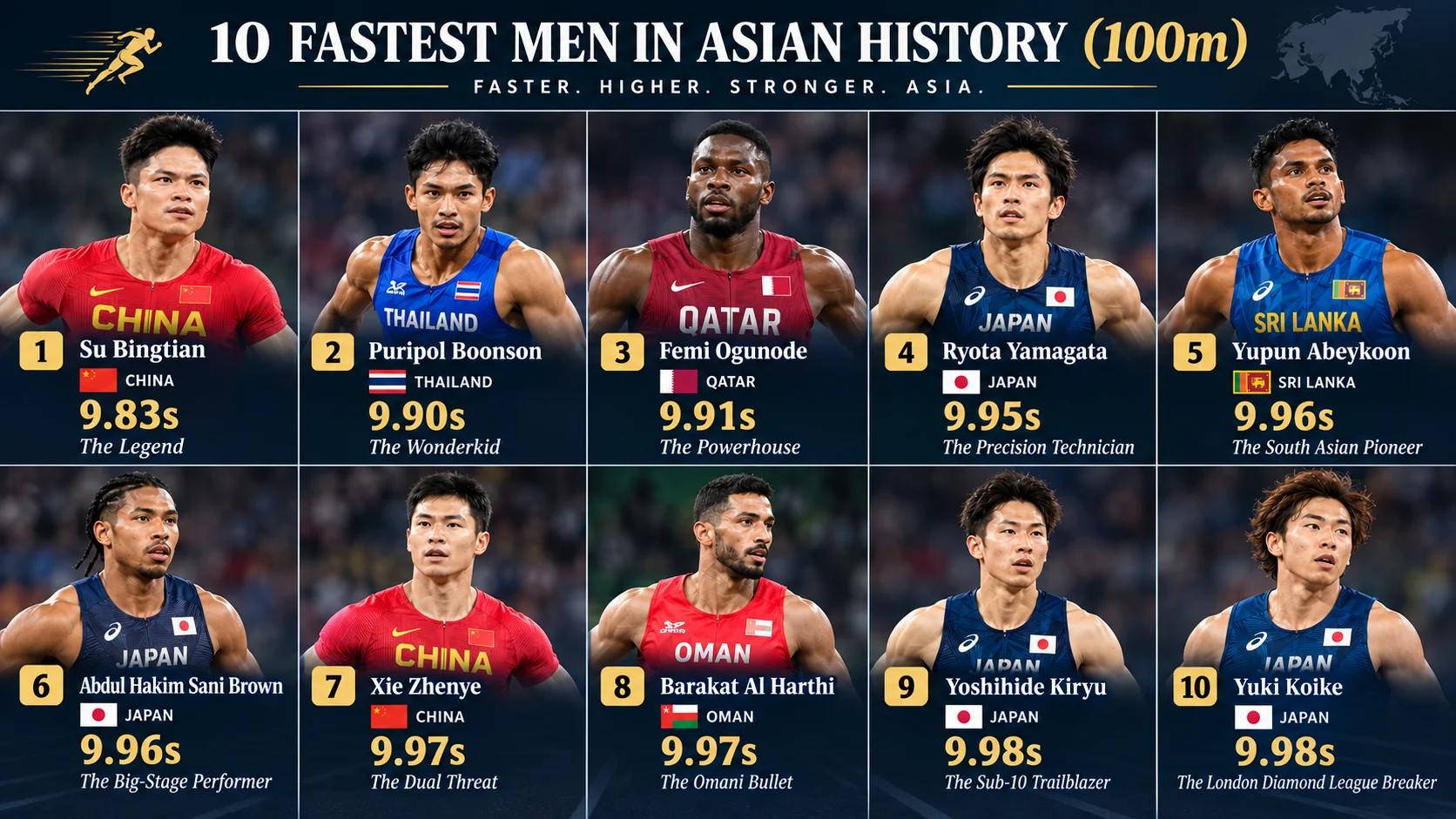
As India’s sprint stars prepare for the explosive 100m semi-finals at the Asian Games 2026, the benchmark for Asian sprinting has never been higher. Breaking the sub-10.00-second barrier was once considered an impossible dream for Asian athletes, but a generation of trailblazers transformed the regional sprinting landscape.
Here is a closer look at the 10 fastest men in Asian history on the 100m all-time list.
1. Su Bingtian (China) — 9.83s
- The Legend: Su Bingtian holds the ultimate crown as the fastest Asian sprinter of all time. His blistering 9.83s run in the Tokyo 2020 Olympic semi-finals set a new Asian Record and proved that Asian sprinters can command the world stage.
2. Puripol Boonson (Thailand) — 9.90s
- The Wonderkid: Southeast Asia’s sprinting phenomenon stunned the world by dropping a mind-bending 9.90s. Combining raw explosive speed with effortless mechanics, Boonson represents the future of Asian sprinting.
3. Femi Ogunode (Qatar) — 9.91s
- The Powerhouse: A long-time titan on the Asian circuit, Ogunode dominated continental championships for nearly a decade. His 9.91s personal best set the gold standard across multiple Asian Games editions.
4. Ryota Yamagata (Japan) — 9.95s
- The Precision Technician: Known for having one of the cleanest starting block executions in the world, Yamagata became Japan’s record holder with a stunning 9.95s performance in 2021.
5. Yupun Abeykoon (Sri Lanka) — 9.96s
- The South Asian Pioneer: In July 2022, Abeykoon made history by becoming the first sprinter from South Asia to breach the sub-10-second barrier (9.96s in Switzerland). A monumental inspiration for Indian athletes targeting sub-10 territory.
6. Abdul Hakim Sani Brown (Japan) — 9.96s
- The Big-Stage Performer: Trained in the US collegiate system at the University of Florida, Sani Brown has consistently delivered on the global stage, anchoring Japan’s global relay dominance and dropping a lifetime best of 9.96s at the Paris 2024 Olympics.
7. Xie Zhenye (China) — 9.97s
- The Dual Threat: A master of both the 100m and 200m, Xie joined his compatriot Su Bingtian in the elite sub-10 club with a 9.97s clocking, cementing China’s status as a sprinting heavyweight.
8. Barakat Al Harthi (Oman) — 9.97s
- The Omani Bullet: Al Harthi broke boundaries for West Asian athletics when he clocked a career-defining 9.97s in 2018, showcasing remarkable consistency across three Olympic Games appearances.
9. Yoshihide Kiryu (Japan) — 9.98s
- The Sub-10 Trailblazer: Kiryu will forever be etched in history as the first Japanese sprinter to officially break the 10-second barrier on home soil with his iconic 9.98s run in 2017.
10. Yuki Koike (Japan) — 9.98s
- The London Diamond League Breaker: Rounding out Japan’s lethal sprinting quartet, Koike achieved his 9.98s personal best in 2019 at the London Diamond League, beating world-class competition down the stretch.
What It Means for Team India
With India’s Gurindervir Singh hunting a sub-10.05s benchmark and Animesh Kujur rising fast through the ranks, matching the raw speed of these top 10 legends remains the ultimate benchmark for Indian track and field.
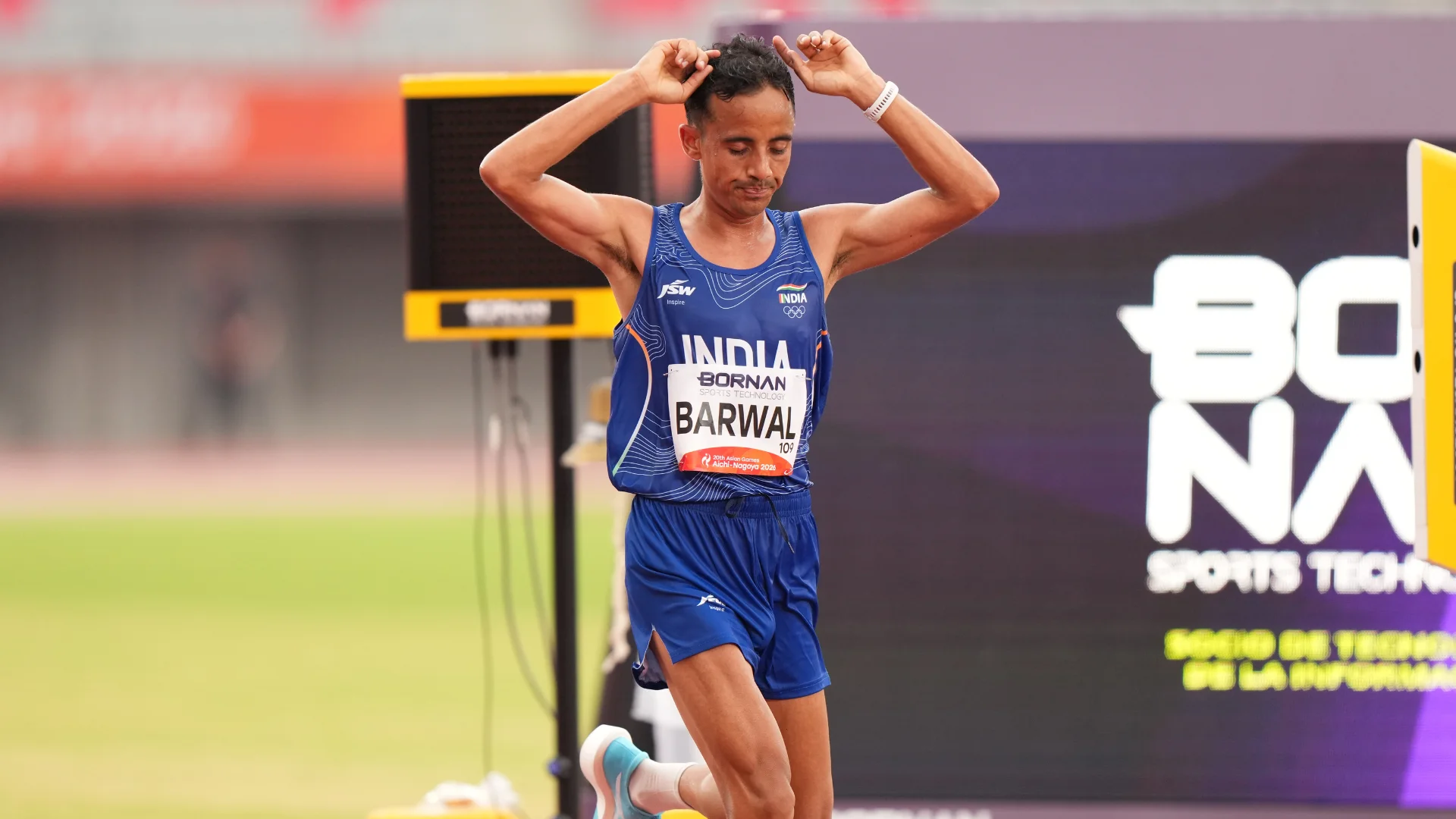
Nagoya: Five months ago, Sawan Barwal achieved something Indian marathon runners had been chasing for 48 years.
On a cold April morning in Rotterdam, the Army runner from Himachal Pradesh broke Shivnath Singh’s long-standing national marathon record. He clocked 2:11:58, becoming the first Indian to run under 2 hours and 12 minutes in the marathon.
The performance finally erased a record that had stood since 1978.
On Saturday in Nagoya, Barwal went even faster. This time, he also secured an Asian Games medal.
Barwal won silver in the men’s marathon at the 2026 Asian Games, clocking 2:11:37 to improve his own national record by 21 seconds.
More importantly, he ended India’s 44-year wait for a medal in the Asian Games marathon.
For a runner competing in only his second marathon, the achievement marks a remarkable rise.
Speaking to NNIS Sports after the race, Barwal said the medal was important because he had won it for India. However, he was already looking ahead to his next challenge.
“I will try even harder next time.”
From a 48-Year-Old Record to a New National Mark
When Barwal arrived in Rotterdam in April, he faced a different kind of challenge.
Shivnath Singh’s national record of 2:12:00 had survived for 48 years. It had become a major benchmark in Indian athletics, resisting generations of marathon runners.
Barwal, however, had never competed in a marathon before.
Despite that, he finished in 2:11:58 and broke the record.
The closing kilometres made the achievement even more dramatic. Barwal struggled badly near the finish and briefly blacked out.
He fell but got back up and completed the race. His time of 2:11:58 was enough to finally replace Singh at the top of the Indian record list.
Five months later, Barwal has lowered that mark once again.
2:11:37.
This time, he also won an Asian Games silver medal.
A Marathon Career That Has Barely Begun
Barwal’s rapid rise is particularly remarkable because the marathon is a relatively new chapter in his career.
The Mandi-born Army athlete previously competed in shorter events, including the 5,000m, 10,000m and half marathon.
He then made the move to the marathon, covering the full distance of 42.195km.
His first marathon produced a national record. Now, his second has brought an Asian Games silver and another national record.
In Nagoya, Barwal stayed with the leading group deep into the race. He was second at the halfway point.
After the 35km mark, the contest had effectively narrowed to three runners.
Japan’s Ichitaka Yamashita eventually made the decisive move to win gold in 2:10:49. China’s Peiyou Feng took bronze in 2:12:13.
Barwal held on to finish second and secure silver.
Barwal Ends India’s 44-Year Wait for an Asian Games Marathon Medal
With his silver medal, Barwal became only the fourth Indian to win a men’s marathon medal at the Asian Games.
India’s previous medals in the event had all come in New Delhi.
At the inaugural Asian Games in 1951, Chhota Singh won gold, while Surat Singh Mathur claimed bronze.
Later, in 1982, Hosur Kukkappa Seetharan won another bronze medal.
Barwal has now added his name to that list. He is also the first Indian men’s marathon medallist at the Asian Games outside India.
His silver in Nagoya marks a significant moment for Indian distance running.
The Significance of Shivnath Singh’s Record
There is an important connection between Barwal’s two national-record performances.
When he broke Singh’s record in April, the achievement went beyond the numbers on the clock.
Shivnath Singh had run 2:12:00 in 1978. His outstanding career also included an 11th-place finish at the 1976 Montreal Olympics.
For almost half a century, Indian marathon runners had tried to break that mark.
Barwal finally did it in Rotterdam.
Former Olympian Nitendra Singh Rawat said after the race that breaking such a long-standing record could encourage other Indian marathoners to target the new benchmark.
He also stressed the need for Indian distance runners to compete more often on fast courses and against stronger international fields.
According to Rawat, these opportunities are important if Indian runners are to move towards the 2:09 range.
Now, Barwal has given them another national record to chase.
“I Will Try Even Harder Next Time”
For Barwal, the Asian Games silver is not the finish line.
Speaking to NNIS Sports after the race, he said the medal was important because he had won it for India. However, he also made it clear that he wants to achieve much more for the country.
“I will try even harder next time.”
After just two marathons, Barwal leaves Nagoya with an Asian Games silver and another national record.
His 2:11:37 performance has made him one of India’s leading distance runners and ended a 44-year wait for an Asian Games marathon medal.
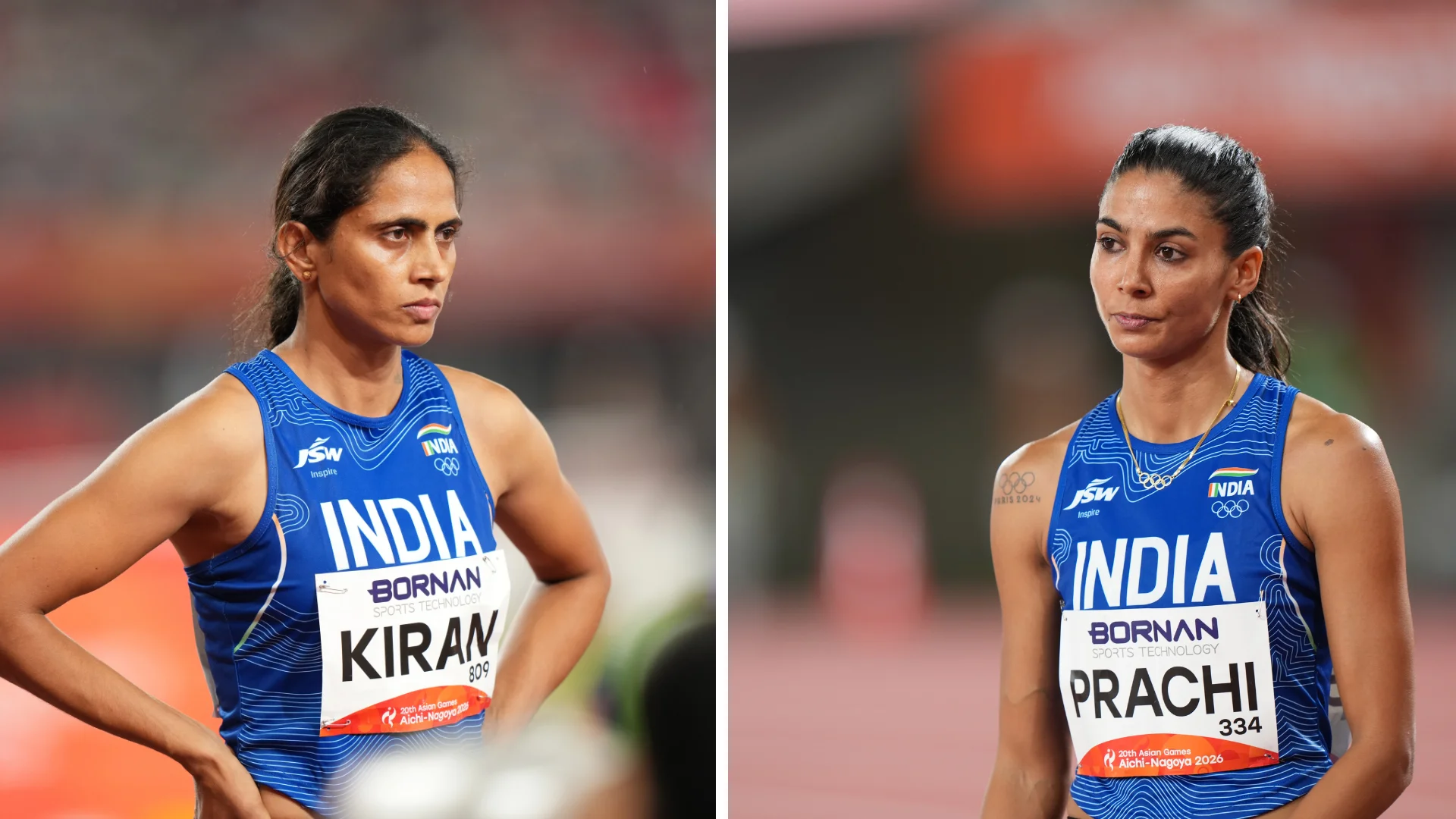
Aichi-Nagoya: India will have two representatives in the women’s 400m final at the Asian Games. Kiran Pahal and Prachi qualified after strong performances in their respective semifinals on Friday.
Pahal finished second in Heat 2 with a time of 53.44 seconds. Meanwhile, Prachi clocked 53.46 seconds to finish third in Heat 3.
Prachi secured her place in the final as one of the fastest non-automatic qualifiers. As a result, both Indians will compete in Saturday’s medal race.
Kiran Pahal Secures Automatic Qualification
Pahal’s individual 400m campaign follows an important contribution to India’s mixed 4x400m relay team.
She ran in the crucial qualifying heat that helped India secure a place in the mixed relay final. This added another demanding race to her Asian Games schedule.
The Haryana international has been one of India’s established 400m runners in recent seasons.
Earlier this week, she won the women’s 400m at the Indian Athletics Series meet in Surat. She clocked 53.49 seconds to claim the victory.
The 25-year-old had also recorded a season best of 52.89 seconds at the Ludhiana leg of the Indian Athletics Series.
Her personal best stands at 50.92 seconds. She also represented India at the 2024 Paris Olympic Games.
At the Asian Games, her 53.44-second performance secured automatic qualification from her semifinal. Consequently, she will now compete for a place on the podium.
Prachi Qualifies Through Fastest Non-Automatic Spots
Prachi took a different route into the final.
She clocked 53.46 seconds to finish third in Heat 3. Although she did not secure automatic qualification, her time was fast enough to earn one of the available non-automatic places.
Her performance means India will have two runners in Saturday’s final.
Both athletes will now have an opportunity to challenge the continent’s leading quarter-milers.
Kiran Pahal Brings Major Championship Experience
For Pahal, the final will come after an already busy Asian Games campaign.
Her schedule has included duties in the mixed 4x400m relay. She has also competed in the individual 400m.
Her experience at major championships, including the Paris Olympics, will be valuable as she returns to the track for the medal race.
Meanwhile, Prachi will also have an opportunity to compete for a medal after securing her place through her semifinal time.
Asian Games Women’s 400m Final: Date and Time
The women’s 400m final is scheduled for September 26 at 6:15 PM IST.
India’s two finalists now have one race remaining in their pursuit of an Asian Games medal.
-
Kiran Pahal: 53.44 seconds — Second in Heat 2.
-
Prachi: 53.46 seconds — Third in Heat 3, qualified as a non-automatic qualifier.
Both are through to the final. Now, the focus shifts to the Asian Games women’s 400m medal race.
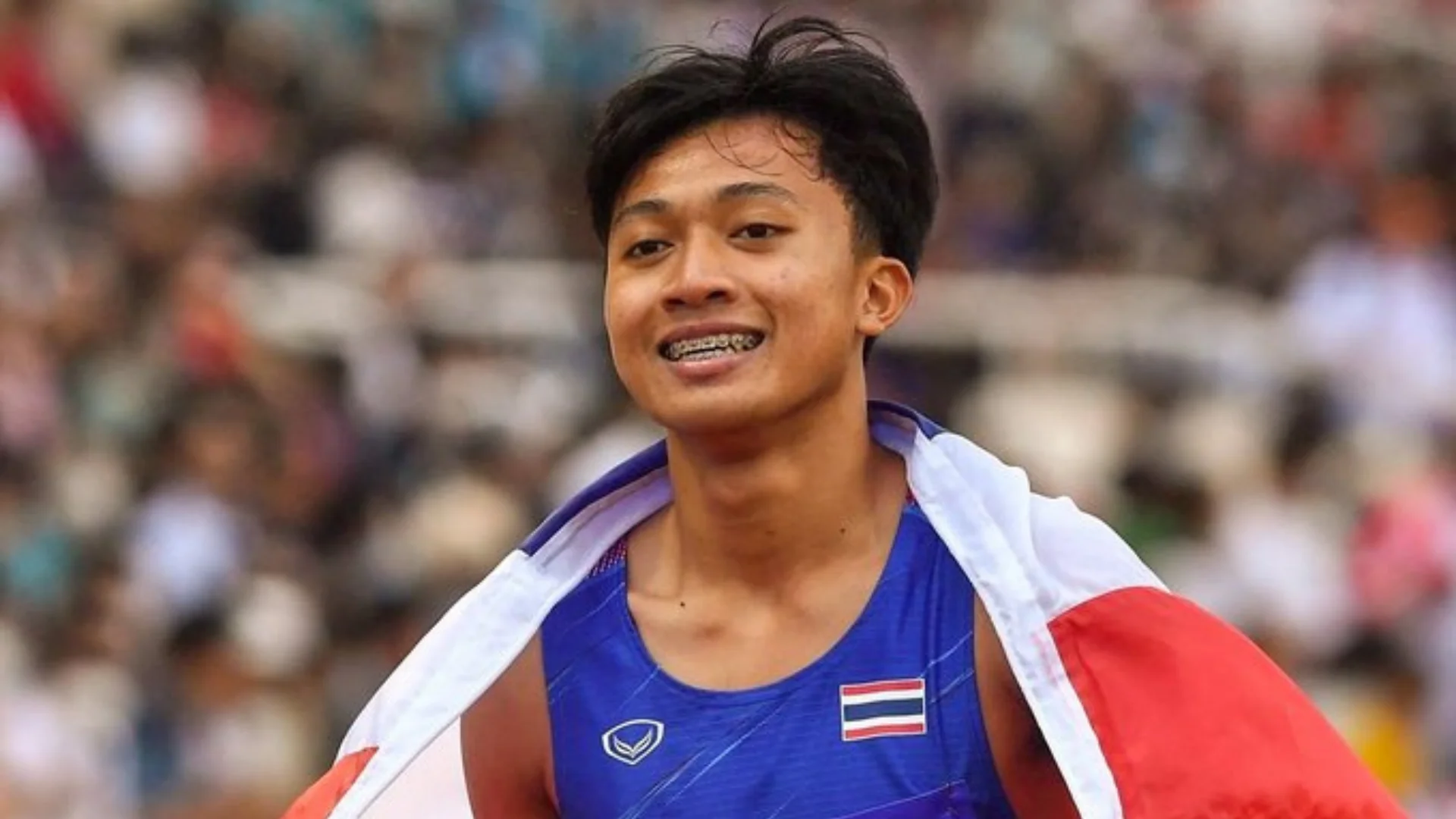
Nagoya: Puripol Boonson won the Asian Games men’s 100m gold on Friday in 9.90 seconds, breaking his own Games record to become Thailand’s sprint champion and cap a remarkable 24 hours in which he twice lowered the continental Games mark.
The 20-year-old had already rewritten the Asian Games record with 9.91 seconds in the semifinal, but found another 0.01 seconds in the final to produce a new personal best and retain his place at the top of the Asian sprinting landscape.
Boonson’s victory completes a rapid transformation from Asian Games silver medallist to continental champion. At the 2023 Hangzhou Games, he was just 17 when he finished second in the 100m in 10.02 seconds.
Three years later, there was no repeat of the silver.
Boonson entered Friday’s final after running 9.95 seconds in Thursday’s heats, before lowering the Games record to 9.91 in the semifinal. He then produced his fastest run of the competition when it mattered most, crossing the line in 9.90.
The time improved his own Games record, Thai national record and personal best.
It also marked another step in the rapid development of a sprinter who has spent the last few years repeatedly lowering the standards for Thai and Southeast Asian sprinting.
Boonson made history in December 2025 when he ran 9.94 seconds at the SEA Games in Bangkok, becoming the first sprinter from Southeast Asia to break the 10-second barrier. The performance also established a new Thai national record.
His progression has not been limited to the 100m.
Boonson is also the Thai national record holder in the 200m, having clocked 20.03 seconds at the Taiwan Athletics Open in June. The performance underlined his ability to compete across both sprint distances and placed him among the leading young sprinters in Asia.
His international breakthrough came at a remarkably young age.
At the 2022 World Athletics Under-20 Championships in Cali, a 16-year-old Boonson finished fourth in the 100m after running a world U18 best of 10.09 seconds in the semifinal.
Two years later, he went a step further at the World U20 Championships, winning silver in the 100m and becoming the first Thai athlete to win a medal at the championships.
The results have made Boonson one of the most prominent young sprinters in the region, but his Asian Games campaign in Nagoya offered a different challenge. This time, he arrived with an established reputation and the expectation of fighting for gold.
He delivered.
The victory also carries significance for Thai athletics. Boonson has ended a long wait for an individual men’s track and field gold medal for Thailand at the Asian Games.
Thailand’s previous individual athletics golds came at the 1978 Bangkok Asian Games, when Suchart Jairsuraparp won the men’s 100m and Usanee Laopinkarn took the women’s 200m title.
Boonson has now added his name to that list, 48 years later.
His victory also keeps alive the possibility of a sprint double in Nagoya. Boonson is expected to compete in the 200m, where he holds the Thai national record and has established himself as one of Asia’s leading performers.
But the 100m was the immediate objective, and he made it count.
The progression across the rounds tells much of the story: 9.95 in the heats, 9.91 in the semifinal, and 9.90 in the final.
Each race was faster than the one before it.
Three years ago, Boonson left the Asian Games with a silver medal and the experience of competing on one of the continent’s biggest stages.
On Friday, he returned to that stage and finished at the top of the podium.
At 20, he is now a SEA Games champion, World U20 medallist, Thai national record holder and Asian Games champion.
And in Nagoya, Puripol Boonson has added another record to his growing list — one that belongs to him twice.
The Asian Games 100m champion is now a 9.90-second man.
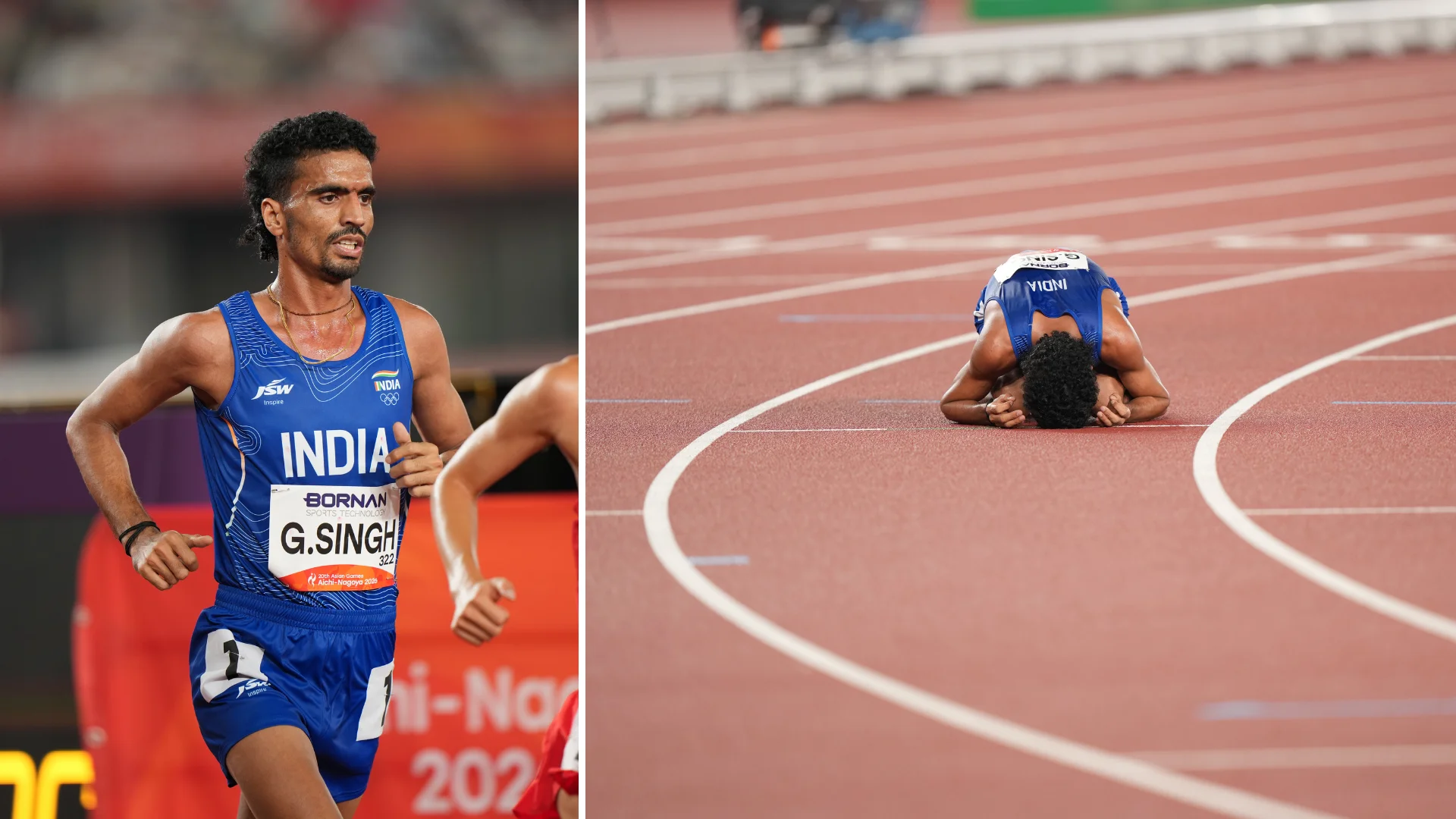
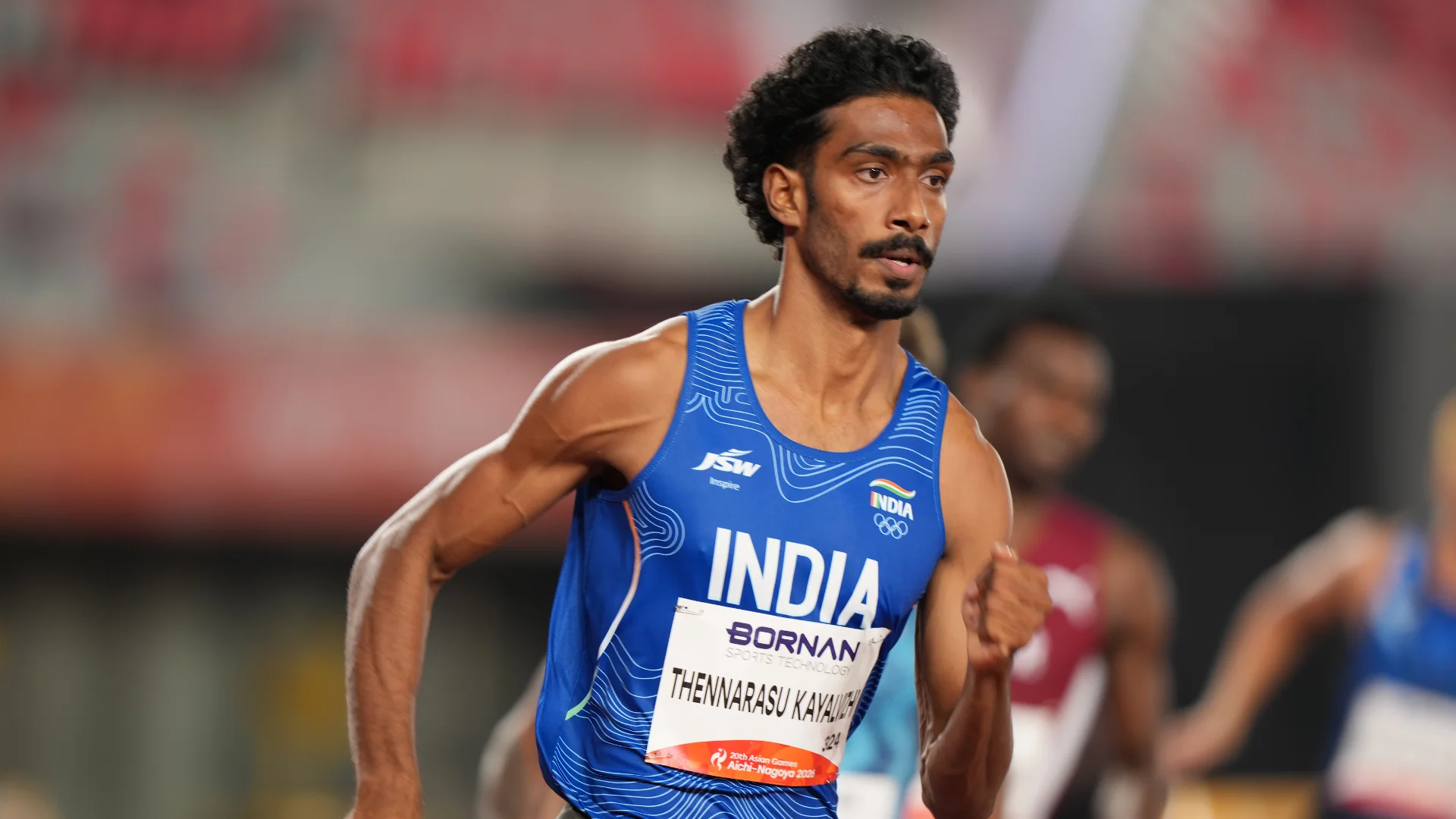
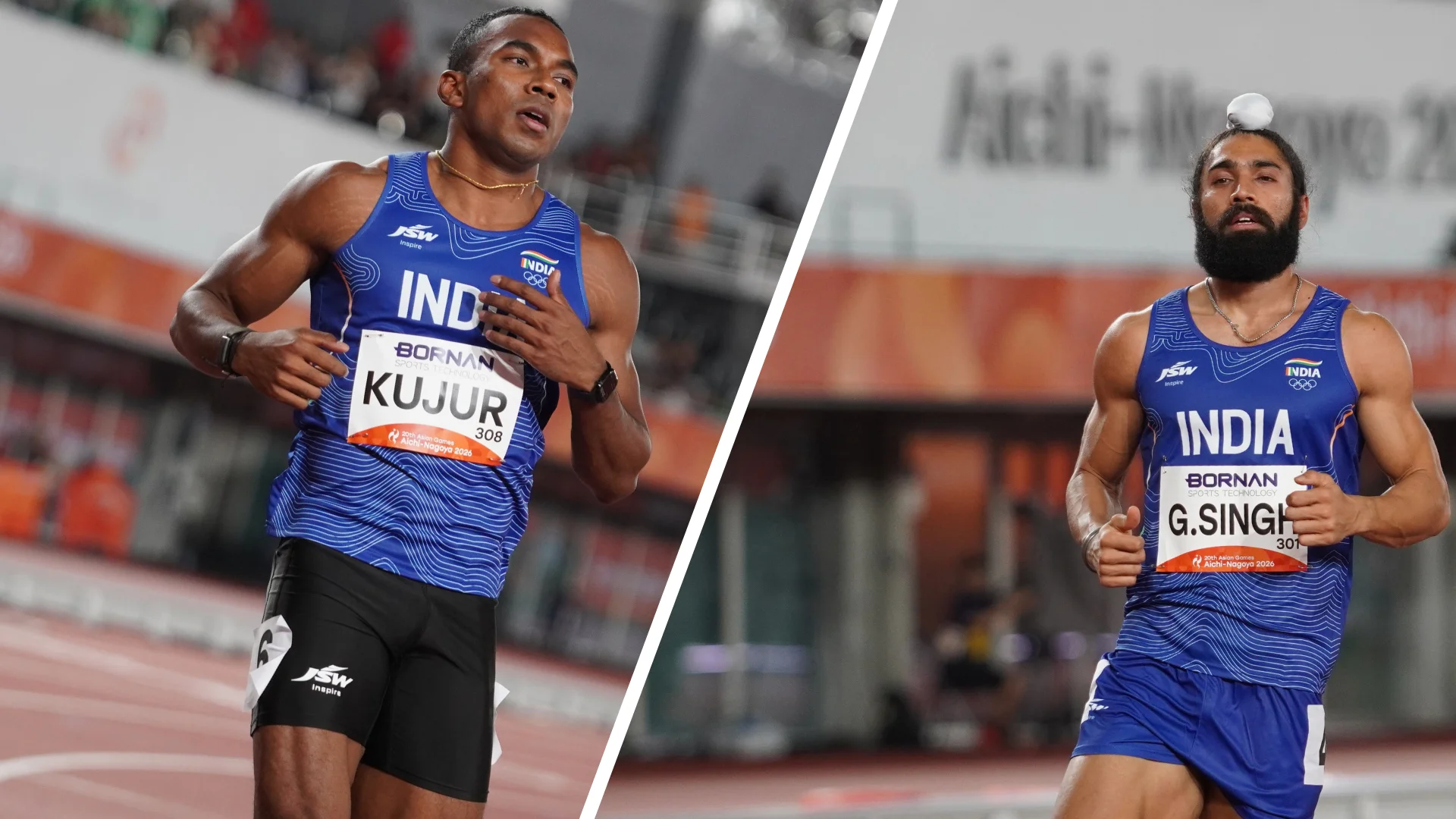
Aichi-Nagoya: India’s much-anticipated men’s 100m campaign ended in disappointment on Friday as Gurindervir Singh and Animesh Kujur crashed out in the semifinals, failing to match the performances that had raised expectations earlier this season.
Gurindervir, India’s national record holder and the country’s fastest-ever man over 100m, finished fifth in his semifinal with a time of 10.32 seconds. Animesh Kujur, the second-fastest Indian in history, finished seventh in his race in 10.38 seconds.
Neither sprinter could reproduce the form that had made them two of the most closely watched Indian athletes heading into the Asian Games.
Gurindervir Singh Finishes Fifth in 10.32 Seconds
Gurindervir finished fifth in his semifinal, missing out on a place in the final.
Oman’s Ali Al Balushi won the race in 10.01 seconds, followed by China’s Xie Zhenye in 10.18 seconds and Daniel Biwesa in 10.22 seconds.
Gurindervir’s 10.32-second finish was not enough to secure qualification for the final.
Animesh Kujur Finishes Seventh in His Semifinal
Kujur also failed to advance, finishing seventh in his semifinal with a time of 10.38 seconds.
South Korea’s Joeljin Nwamadi won the race in 10.17 seconds, while Malaysia’s Mohd Muhammad clocked 10.25 seconds and Japan’s Yuki Koike finished in 10.31 seconds.
Kujur’s performance ended his hopes of reaching the final.
A Disappointing End to a Remarkable Season
The semifinal exits were particularly disappointing given the performances both sprinters had delivered earlier this season.
Gurindervir arrived in Aichi-Nagoya as the national record holder with a personal best of 10.09 seconds. He became the first Indian to break the 10.10-second barrier when he clocked that time in Ranchi in May.
His record-breaking performance had raised expectations for the Asian Games, with the sprinter openly targeting a breakthrough on the continental stage.
Kujur, meanwhile, had established himself as one of the biggest stories in Indian sprinting. The 200m national record holder clocked 10.14 seconds, setting the fastest 100m time by an Indian on foreign soil and the second-fastest mark by an Indian overall, behind Gurindervir’s 10.09 seconds.
Gurindervir-Kujur Rivalry Raised Expectations
The rivalry between the two sprinters had been one of the most intriguing developments in Indian athletics this year.
In May, the national record changed hands twice within minutes. Gurindervir first clocked 10.17 seconds before Kujur lowered the mark to 10.15 seconds.
Gurindervir reclaimed the record the following day with his historic 10.09-second performance.
That remarkable sequence made Friday’s semifinal results particularly difficult to digest.
Both Sprinters Had Advanced Safely Through the Heats
Gurindervir and Kujur had progressed to the semifinals after successfully negotiating their heats on Thursday.
Kujur finished third in 10.36 seconds, while Gurindervir placed second in 10.38 seconds. Both secured automatic qualification for the next round.
Their performances in the heats had raised hopes for a strong showing in the semifinals.
Gurindervir had said he would run faster in the later rounds, while Kujur, speaking exclusively to NNIS Sports, described his heat as an easy race and set himself a target of 10.01 seconds for the semifinal.
However, neither sprinter managed to improve on his heat performance.
Both Indians Fall Short of Their Personal Bests
Gurindervir finished 0.23 seconds slower than his national-record time of 10.09 seconds, while Kujur was 0.24 seconds outside his personal best of 10.14 seconds.
At the semifinal stage of a 100m race at this level, those margins can make a significant difference.
India had entered the Games with two sprinters capable of competing at the sharp end of the Asian field. Neither could reproduce that level when a place in the final was at stake.
For Gurindervir, the fifth-place finish marks a missed opportunity after a season in which his 10.09-second performance had changed perceptions of Indian sprinting.
For Kujur, seventh place is equally frustrating after a year in which his rivalry with Gurindervir had repeatedly pushed both athletes to new heights.
No Indian in the Men’s 100m Final
There will be no Indian representation in the men’s 100m final at Aichi-Nagoya.
The Asian Games had offered Gurindervir and Kujur an opportunity to turn a remarkable domestic season into a major international breakthrough. Instead, both sprinters saw their campaigns end in the semifinals.
Their talent and performances earlier in the season had raised expectations, but neither could deliver the same level on the biggest day of the competition.
On Friday, both fell short of the performance needed to reach the final.
As the race unfolded, Bahrain’s Winfred Yavi bobbed up and down in the lead, while Ruth Jebet surprisingly began to fade. Meanwhile, Nozomi Tanaka of Japan stuck tenaciously to the front, threatening an upset on the final lap before Yavi’s world-class, loping strides and devastating 200-meter sprint broke the resistance.
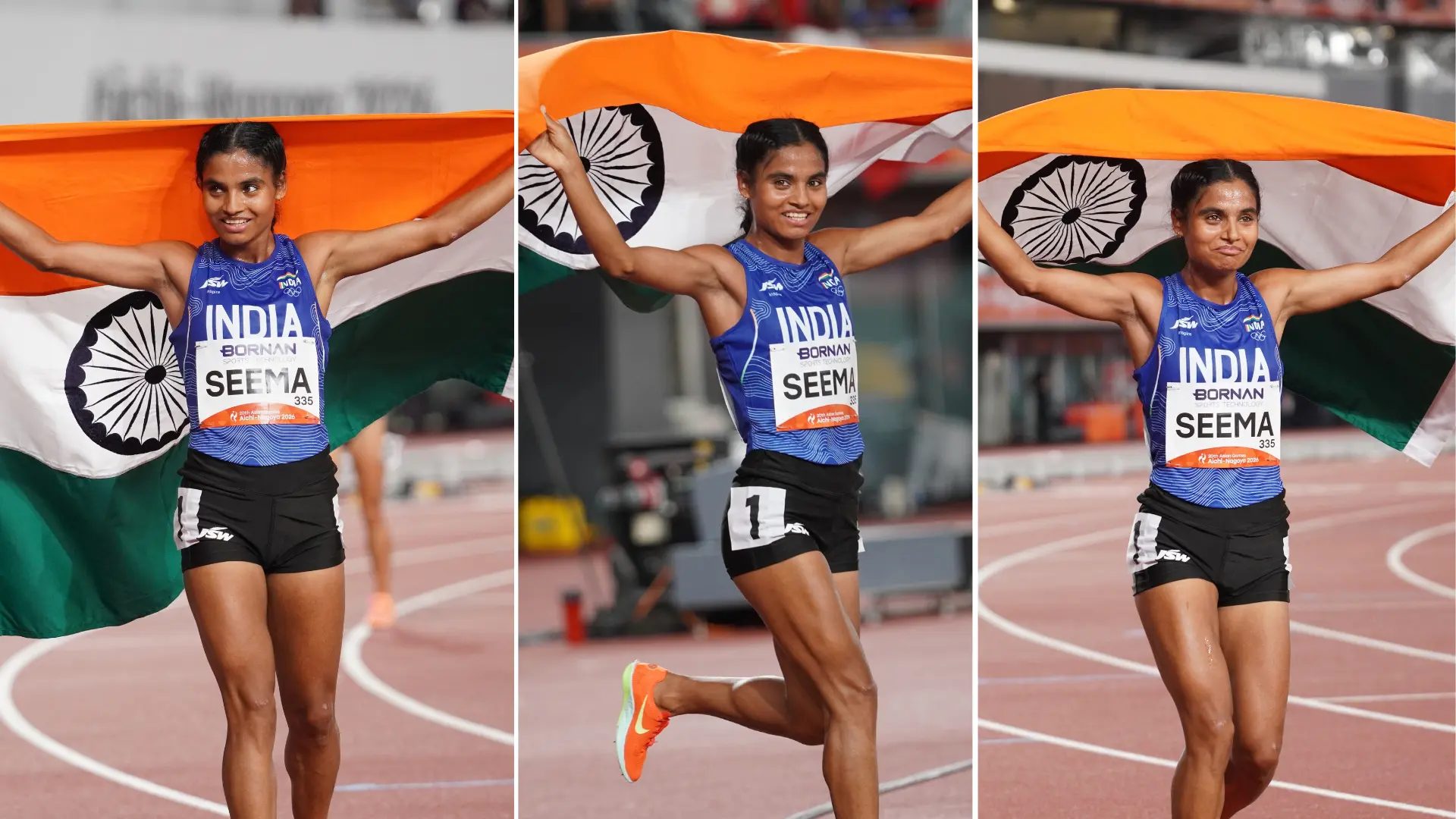
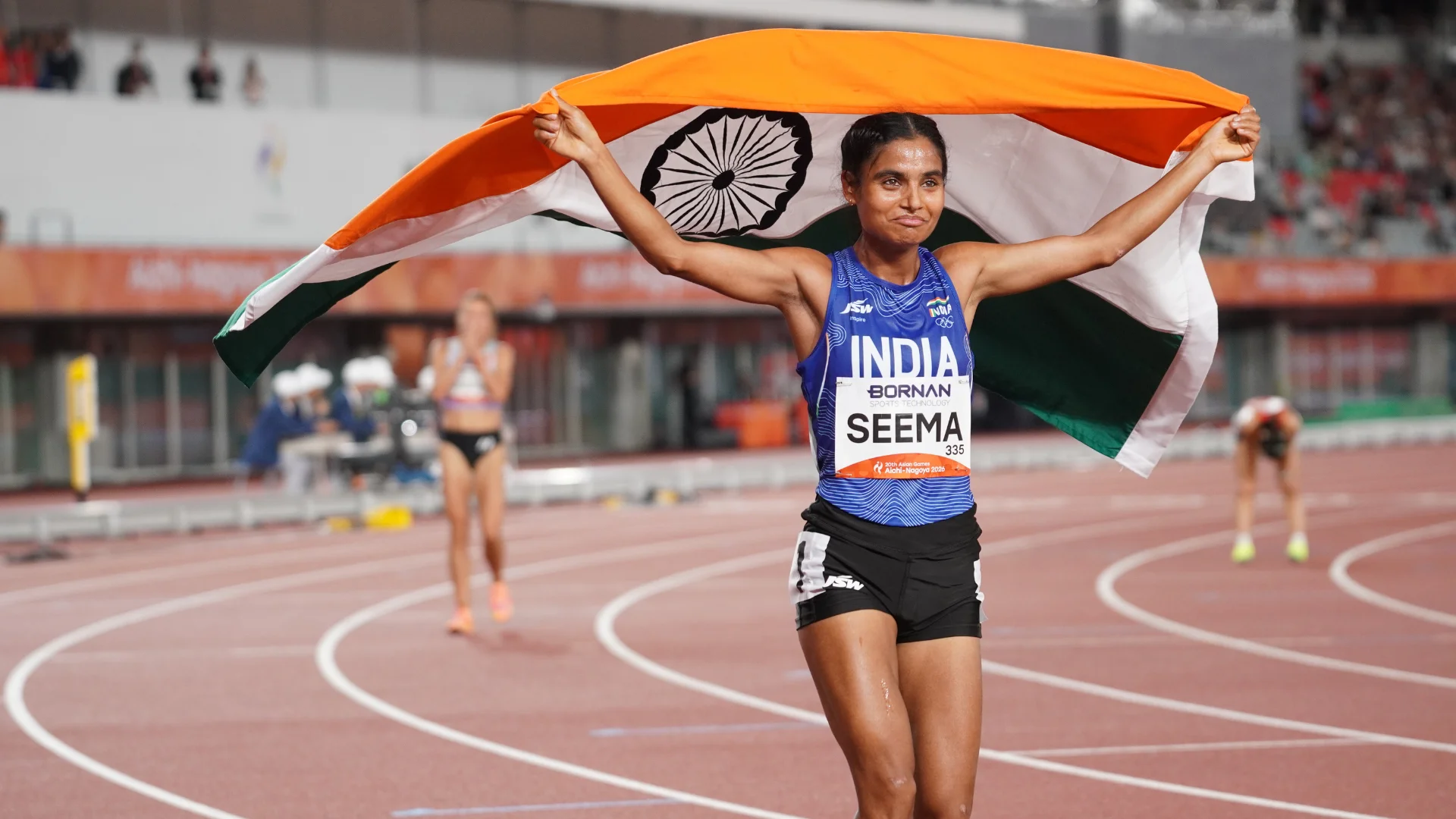
Amidst this elite fray was Seema, the diminutive Indian distance runner taking a giant step onto the international stage.
“Because it was my first Asian Games, and everyone wants to win gold for their country, I also fought to win gold. But I won the bronze medal. I am happy.”
For Seema, the race wasn’t just physical; it was a course of unexpected trials. Unknown to most, a foreign object had lodged itself into her shoe early on.
“Did you get hurt in your shoes? Yes, I got a sticker on my foot. But I didn’t see it. I didn’t pay much attention.”
That resilience defined her race. When the initial slow tempo didn’t suit her and the pack began playing tactical games, Seema adapted on the fly. When Yavi and the leaders finally threw down the hammer in the final laps, Seema dug deep. Could she have grabbed silver instead of Tanaka? Yes, she could have. That is the eternal crossroads for a 10k runner: when to surge and when to bide your time. Securing bronze in 32:50.05 was a steep learning curve, but one she handled with maturity.
This podium finish was no accident. It is the product of meticulous planning, gruelling overseas camps, and an unbreakable mindset. Training in the United States for the last three years, with the support of the Athletics Federation of India (AFI), SAI, and TOPS, has transformed her trajectory.
Recent months saw the squad complete a high-intensity, two-and-a-half-month block in the U.S., returning home just a week prior to the Games. “It is very beneficial for us because there are tough conditions there, and we train with Olympic champions. Since the Olympic Games will be held in Los Angeles in 2028, it prepares our mindset to compete.”
Wrapped proudly in the tricolour, Seema looked back at a journey that includes a silver medal at the 2025 World University Games. But the story is far from over.
With her next event, the 5000 meters, approaching on September 28th, Seema is eager to apply the tactical lessons learned on the 10k track.
“My next event is the 5000 meters. I will try my best to change the colour of my medal.”
Guided by mentors who always remind her, “Seema, you are the best. You are a fighter,” she has proven she can take a punch, adapt to chaos, and deliver when it matters most.