





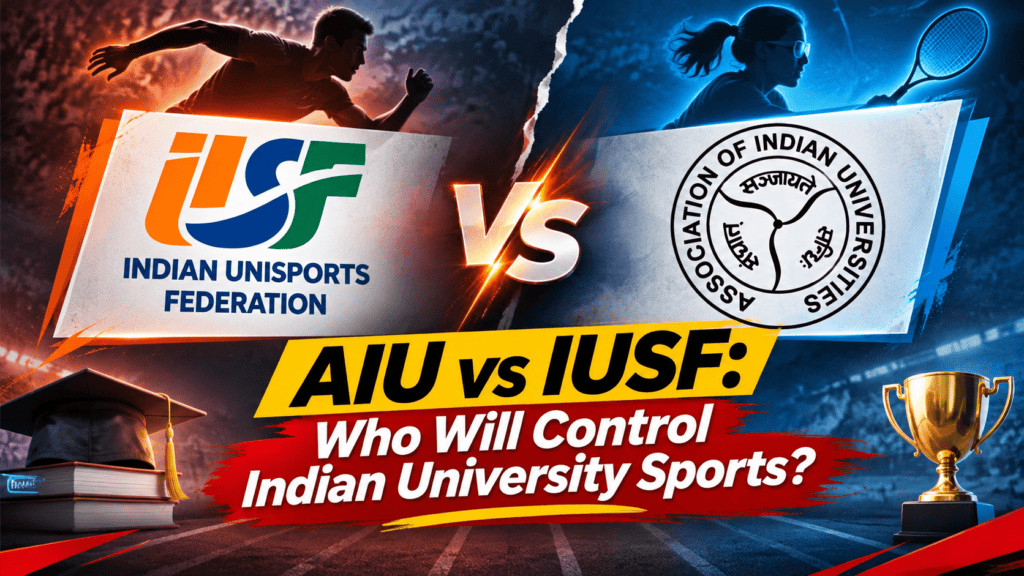
For decades, university sports in India have served as the bedrock of national talent identification. Globally, the collegiate system acts as the premier incubator for world-class athletes. For example, it has produced NCAA track icons in the United States and supported elite university programmes across Europe and East Asia. In India, however, the grassroots pipeline has long struggled with administrative inefficiency. As a result, collegiate athletes have often found themselves caught between bureaucratic power struggles and missed international opportunities.
Now, the high-stakes battle for control of Indian university sports has reached a boiling point. Recently, the Ministry of Youth Affairs and Sports moved to strip the Association of Indian Universities (AIU) of its long-standing mandate. Instead, it handed control to the newly formed Indian Unisports Federation (IUSF).
However, this transition has encountered a major legal roadblock. The Delhi High Court has stayed the Ministry’s recognition of the IUSF. Consequently, the matter is now set for a critical hearing on January 13, 2027.
1. Why Did the Sports Ministry Move Against AIU?
The breaking point for the Ministry came after a series of high-profile administrative failures. In particular, the immediate trigger was India’s troubled organisational experience at the 2025 FISU World University Games in Rhine-Ruhr, Germany. This was followed by nationwide criticism over low athlete participation at the 2025 Khelo India University Games.
Following these lapses, AIU Joint Secretary (Sports) Dr. Baljit Singh Sekhon was suspended. Moreover, the Ministry had reportedly been dissatisfied with AIU’s functioning since as early as July 2025. Therefore, it decided to phase out the existing nodal arrangement in favour of a dedicated National Sports Federation (NSF).
On October 5, 2026, the Sports Ministry granted provisional NSF recognition to the IUSF, which had staked its claim in July 2026. To accelerate the transition, the Ministry reportedly relaxed several standard eligibility criteria through an official letter to the IUSF Secretary General. These included:
- The mandatory three-year existence requirement.
- Having affiliated units across at least 50% of Indian districts.
- Pre-existing affiliation or recognition with an international sports body.
The New Leadership Structure
Following the Ministry’s recognition, the IUSF moved ahead with its leadership appointments. On October 11, 2026, Prof. Achyuta Samanta was unanimously elected President of the newly formed federation.
| Position | Executive Member / Officer |
|---|---|
| President | Prof. Achyuta Samanta |
| Vice-Presidents | Prof. Rajesh Tripathi, Dr. U. V. Shankar, Prof. Kalpana Sharma, Dr. Kanwar Mandeep Singh |
| Secretary General | Dr. Binu George Varghese |
| Treasurer | Dr. Bhasker Shukla |
| Joint Secretaries | Dr. Kavita Kholgade, Dr. Kaukab Azeem |
| Executive Members | Dr. V. Mahadevan, Dr. Aminul Haq, Dolla Banerjee, Sagar Joshi, Anju Bobby George, Rajiv Tomar |
2. The Legal Stalemate: AIU Takes the Government to Court
However, the transition soon faced a legal challenge when AIU filed a petition before the Delhi High Court. In its petition, AIU argued that it had served as a recognised National Sports Promotion Organisation for university sports since May 5, 2008. Furthermore, it claimed that the government was withdrawing its status without providing prior notice.
At the centre of this dispute is international representation. Under the International University Sports Federation (FISU) statutes, only one representative organisation per country can hold active membership. Currently, FISU recognises AIU as India’s official member association. Notably, AIU has held this status since 1967.
Meanwhile, the Sports Ministry has given the IUSF six months to secure FISU affiliation. However, achieving this while AIU retains its historic membership could prove difficult. Furthermore, the Delhi High Court has stayed IUSF’s recognition until January 13, 2027. As a result, the governance structure of Indian university sports remains locked in legal uncertainty.
3. Ground Reality: What This Means for Athletes
While the legal battle continues, coaches and athletes face immediate concerns about competition schedules, selection trials, and the All India University Championships calendar.
Nevertheless, NNIS Sports spoke to several national coaches, who confirmed that ground-level preparations remain on schedule for now. According to them, the current arrangements include:
- Selection Process: Ongoing Inter-University competitions will continue to serve as the baseline selection route.
- National Championship: Meanwhile, the All India University Championships are set to proceed in the final week of December 2026 at KIIT University.
- Athletics Schedule: In particular, track-and-field events are confirmed for December 26–31, 2026, on the KIIT Synthetic Track.
Therefore, coaches expect the existing competition framework to remain in place through the winter. However, the situation beyond this period remains uncertain.
4. The Looming Crisis: FISU World University Games 2027
Ultimately, the biggest test of this administrative rift will come at the FISU World University Games (Summer). The competition is scheduled to take place from August 1–12, 2027, in Chungcheong, South Korea.
Meanwhile, selection trials for the 2027 Games are scheduled for April 2027. This leaves the Sports Ministry with a tight deadline to resolve the governance dispute and settle the question of international recognition.
Collegiate sports play a crucial role in connecting youth development with senior international podiums. Therefore, resolving this administrative impasse is essential. As the countdown to Chungcheong 2027 begins, Indian sports authorities must ensure that university athletes do not lose their pathway to international competition.