





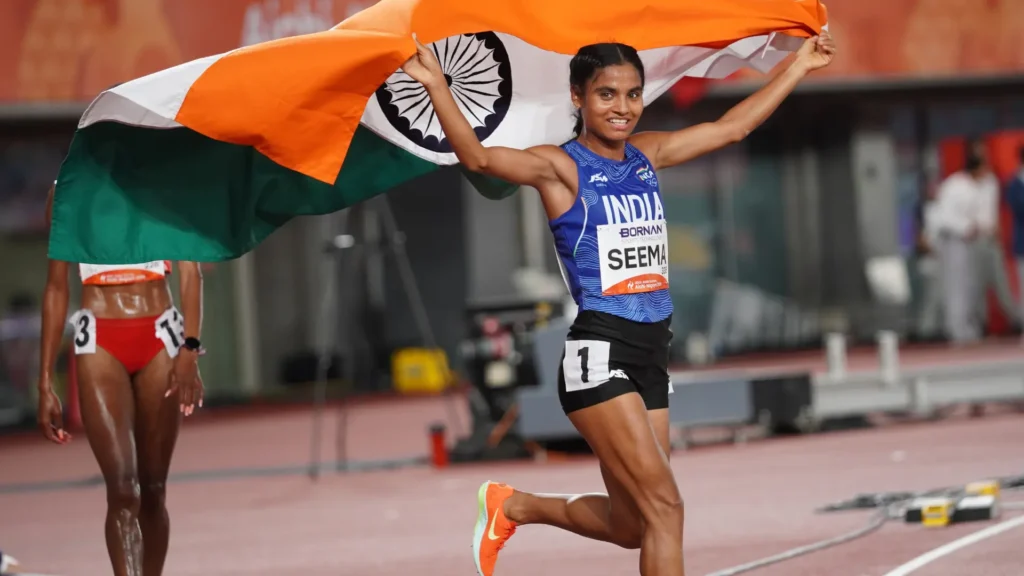
Ending a 16-year medal drought for India in the Women’s 10,000m at the Asian Games, Seema’s bronze-medal performance in 32:50.05 was a triumph of mental resilience, tactical flexibility, and biomechanical control. Championship 10,000-meter races are rarely simple time trials; they are grinding mental battles where variable pacing, field density, and unexpected physical discomfort can derail an athlete’s race plan in an instant. Seema’s run offered distance runners everywhere a blueprint in overcoming adverse conditions under intense competition.
From the gun, the race established an unorthodox, highly variable “yo-yo” tempo. With none of the pre-race favorites willing to take on early wind resistance at the front, the pack ambled through an exceptionally slow opening 1,000 meters in 3:18, eventually passing the 5,000m midpoint in a conservative 16:52. Recognizing that a steady-state time-trial approach was useless in such a tactical field, Seema immediately adapted her strategy. Instead of pushing to the front or dropping back, she tucked herself deep inside the main pack, conserving aerobic energy while staying alert to sudden pace accelerations.
Compounding the tactical challenge was an acute physical irritation: early in the race, a foreign adhesive sticker became lodged inside Seema’s shoe. In a 25-lap track event, continuous friction against the foot can easily compromise stride mechanics, leading to altered force application, early muscle fatigue, or premature surrender. Seema mentally compartmentalized the discomfort. She maintained a stable cadence, kept her foot strike consistent, and avoided over-compensating on her opposite leg, keeping her stride symmetric despite the irritation.
As the race reached the critical 8,000-meter mark, the lead pack began to fracture under sudden, violent surges from elite international athletes. Leveraging the massive aerobic engine developed during high-altitude training camps in Colorado under Coach Scott Simmons, Seema began her move. While rival runners faltered under late-race fatigue, Seema held a tight, economical line around the bends, steadily passing former champions—including Ruth Jebet and Daisy Jepkemei—by maintaining high stride turnover.
When global stars Winfred Yavi (32:39.18) and Nozomi Tanaka launched their devastating final 400-meter kicks for gold and silver, Seema remained composed. Knowing her physiological limits, she executed a controlled terminal kick to defend her position against the chasing pack, crossing the finish line in 32:50.05 to secure the bronze medal. Seema’s historic run demonstrated that world-class endurance requires more than raw engine size—it demands the adaptability to navigate tactical chaos and the mental toughness to override physical pain.