





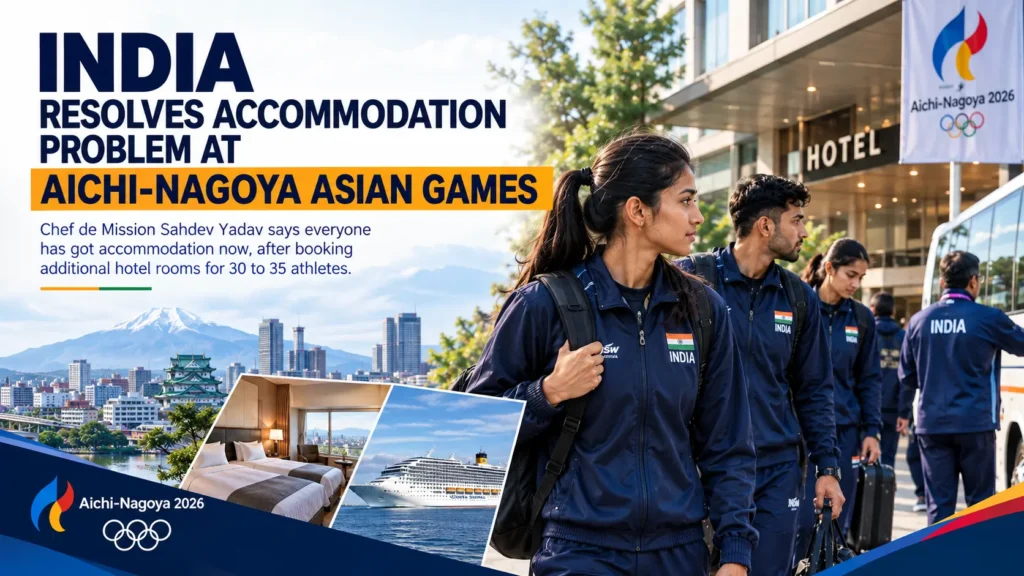
India has resolved its accommodation problem at the Aichi-Nagoya Asian Games, Chef de Mission Sahdev Yadav said. The issue affected 30 to 35 Indian athletes.
The Indian delegation booked additional hotel rooms after some athletes were removed from the accommodation list provided by the organisers.
“Everyone has got accommodation now,” Yadav told the media in Nagoya on Friday, a day before the opening ceremony of the Aichi-Nagoya Asian Games.
India books additional hotel rooms
The problem emerged after the Indian contingent arrived in Japan. Yadav said India had stayed within the number of rooms for which it had been invoiced.
“We stuck to the number of players they had invoiced. But they removed some names, so we booked hotels for them,” Yadav said.
The issue affected around 30 to 35 athletes. Members of India’s badminton and shooting contingents were among those affected.
India acted quickly to address the problem. Yadav said the delegation had already booked 18 additional rooms.
Another 10 rooms were being arranged.
The immediate question of where the affected athletes would stay now has a clear answer.
They have rooms.
Aichi-Nagoya faces wider accommodation challenges
The accommodation issue adds another complication to the Games build-up.
Aichi-Nagoya does not have a conventional Athletes’ Village. Instead, the organisers have spread participants across hotels, temporary accommodation and the Costa Serena cruise ship.
The cruise ship is being used to house thousands of athletes and officials.
The Olympic Council of Asia has defended the decision not to build a traditional village. It has argued that a large facility for a short sporting event could leave the host with an expensive legacy problem after the Games.
The OCA has also pointed to the scale of the event.
More than 11,000 athletes from 45 countries and regions are expected to compete across 43 sports. The total number of athletes and officials is around 17,000.
Accommodation model draws attention
The alternative accommodation model has already attracted attention.
There have been complaints about cramped rooms and beds that are too short.
Japan’s own delegation has sought alternative accommodation after reports that some male and female athletes were assigned shared rooms.
The Costa Serena cruise ship has also become part of the Games’ logistical puzzle.
For India, accommodation has not been the only logistical concern.
Accreditation and transport create more challenges
Yadav said the accreditation process has taken longer than expected. The delay has particularly affected athletes staying on the cruise ship.
The Indian delegation has therefore made additional arrangements for cars and hotels.
These arrangements will help athletes move between accommodation and venues without unnecessary delays.
Food and travel distances have also caused concerns.
Indian athletes have spoken about limited food options. Meanwhile, shooting contingents have faced journeys of 50 to 60 kilometres between hotels and competition venues.
Yadav acknowledged that there had been “some mismanagement”. However, he stressed that the priority was to fix the problems rather than dwell on them.
India settles athletes before opening ceremony
India now enters the eve of the opening ceremony with the immediate accommodation issue resolved.
The delegation has booked additional rooms and arranged transport alternatives. Athletes are also being settled.
However, logistical issues have dominated the conversation around these Asian Games before the opening ceremony.
Rooms. Transport. Accreditation. Food.
Weather has also added another concern.
Nagoya was hit by record rainfall last week. The weather forced hundreds of athletes and staff to briefly evacuate their accommodation.
Now there is the possibility of a typhoon adding another complication.
None of this means the Games are in danger of failing. Competition has already begun, venues are functioning and organisers have contingency plans.
With the opening ceremony only a day away, Nagoya has already highlighted the complexity of hosting a multi-sport event.
Getting thousands of athletes to the starting line can be almost as complicated as getting them across it.
For India, at least, the room problem is now off the list.
The athletes can concentrate on the medals.