




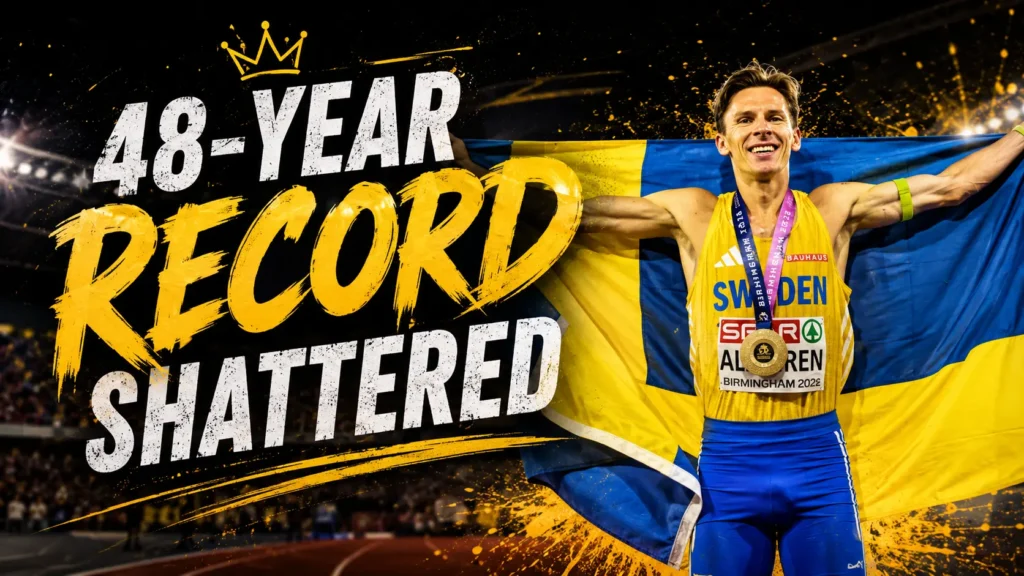
What began as a tactical Sunday jog transformed into a demolition at the Alexander Stadium. Sweden’s Andreas Almgren delivered one of the most defining 10,000m races in championship history, executing a master-level long-distance strategy that left the rest of the elite field completely dismantled. By grinding down his rivals through sustained, punishing splits and ultimately lapping almost the entire 25-man field, leaving only six runners unlapped, Almgren captured the European title in 27:23.44 and erased Martti Vainio’s legendary 1978 record – the longest-standing championship record on the books – after 48 years.
Long-distance running is rarely just about raw speed; it is an exercise in psychological and physical attrition, and Almgren understood pacing tactics better than anyone else on the track. The race opened at a deceptively pedestrian pace, featuring a dawdling opening kilometre of 3:16.93 and slow initial laps of 83.23, 75.56, and 78.12. For a brief moment, Vainio’s old Prague mark of 27:30.99 appeared safe for another two years. But Almgren sensed hesitation in the pack of 25 and seized the initiative on the fourth lap with a sharp 65.25.
What followed was a brutal exhibition of front-running. For the next 14 laps, Almgren locked into a relentless, metronomic rhythm of 63 to 64 seconds. Only a credentialed trio – reigning world 10,000m champion Jimmy Gressier and the last two European champions, Dominic Lobalu and Yemaneberhan Crippa – dared to follow. Yet even this elite trio was reduced to single-file survival mode. Almgren turned the screw further with successive laps of 63.07, 62.18, and 61.22, effectively snapping the elastic and breaking his challengers.
Covering the second 5000m in a blistering 13:17.74, Almgren surged past runners in waves, evoking memories of Paula Radcliffe’s iconic 2002 Munich victory. Even as he battled sheer exhaustion over the closing stages, his tactical dominance was absolute.
Reflecting on the gruelling effort, Andreas Almgren shared: “It was quite amazing, I really wanted to go for it today. There was such a good atmosphere around this whole stadium, so I thought I might as well go for it, for that record. I really needed that support, as during the last five laps, I felt like I was dying.”
As Almgren slowed slightly toward the end – briefly acting as an unofficial pacemaker for the sizeable group contending for minor places – he still crossed the line nearly 20 seconds ahead of the rest, already draped in a Swedish flag.
Behind him, the battle for the remaining podium spots played out in fierce isolation. Swiss Dominic Lobalu ran the final two kilometres in total solitude to secure a hard-earned silver medal in 27:42.67, noting afterward: “I obviously wanted to defend my title, but Almgren was too strong. I couldn’t hold that pace any longer. I am very happy for him; he always fights a lot and makes the races hard. The faster pace suited me. I wasn’t sure how fast it would be, but I was less confident of doing well if it was a slower race.”
Meanwhile, the Frenchman Jimmy Gressier utilized his trademark closing speed, burning off Crippa with a thunderous 25.6-second final 200m, to claim his maiden European medal in 28:07.90, some 250 metres behind the champion. Gressier reflected on his performance and tactical redemption:
“I am very happy for my first European medal today. To win I would need stronger legs. Andreas is just too strong and he had good tactics, so I am very happy with this medal. I guess he went from the front because he knew many of us were tired from the 5000m. So, it was very tactical from him. This result is good redemption for Munich and Rome – I finished fourth in Munich and Rome – so now it is my first medal, and I think it is a reason to celebrate it.”
Just behind on the line was Italian Yemaneberhan Crippa, who took an unlucky fourth place in 28:08.56 after a fierce cat-and-mouse battle over the closing laps. As Almgren celebrated his historic victory, Finnish legend Lasse Viren looked on from the stands of the Alexander Stadium, witnessing another glorious chapter added to Nordic distance running history.