





Sunday was one of those rare days when Indian sport seemed to move in fast-forward. Ayush Shetty clinched a historic silver at the Asian Championships, becoming only the second Indian after Dinesh Khanna to reach such heights. At the same time, Sawan Barwal rewrote history by breaking a 48-year-old national record in the marathon.
Yet, in the middle of all this noise, one performance quietly slipped under the radar and perhaps, it shouldn’t have.
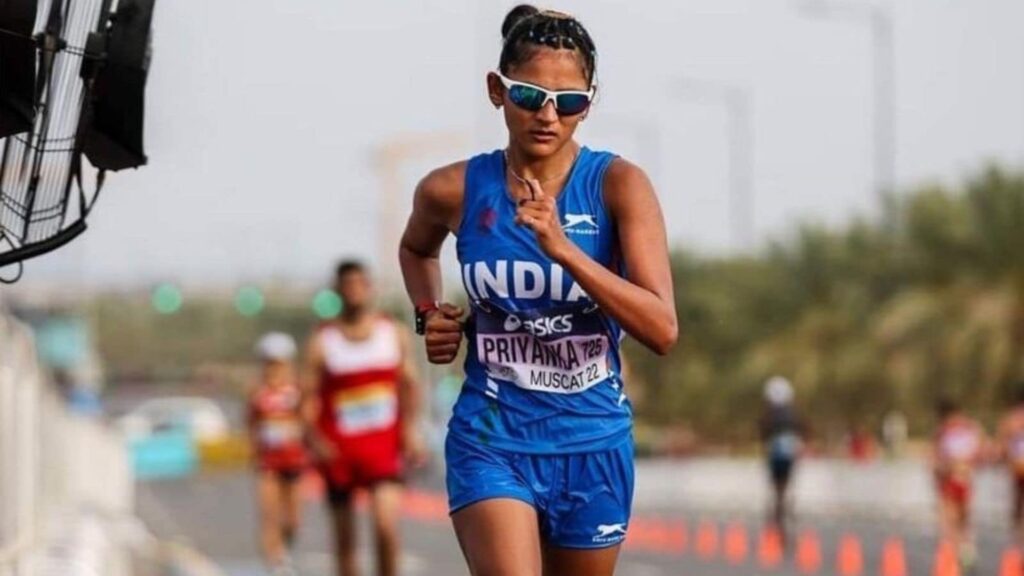
Priyanka Goswami finished 10th at the World Race Walking Team Championships 2026 in Brasília. On paper, it may not scream headlines. But in context, it might just be the most significant performance by an Indian athlete that day.
Priyanka clocked 3:43:01 in the women’s marathon race walk, in a field stacked with Olympic medallists and world-class athletes. Ecuador’s Paula Torres won gold with a stunning 3:24:37, the second-fastest time ever.
But Priyanka’s race was never about the podium. It was about endurance, adaptation, and mindset.
Speaking exclusively to NNIS Sports, she said, “The timing was good because the altitude here is 1200m. Sometimes, we need to step out of our comfort zone.”
That “comfort zone” included a 38-hour journey from India to Brazil, minimal acclimatisation, and the challenge of a new race format. Yet, she delivered.
Priyanka has a decorated resume silvers at the Commonwealth Games, Asian Championships, and bronze at the World University Games. But even she believes this performance stands above them.
“You were competing among the best walkers in the world and finished 10th. This is the biggest achievement of your life,” her coach Ronald Weigel told her, a sentiment she agrees with.
And rightly so. Unlike continental events, this was a truly global field. Every athlete on that start line was elite. Finishing in the top 10 here is not just a result, it’s validation.
The event itself marked a shift. The traditional 20km and 35km races were replaced by half marathon and marathon distances.
“It makes a big difference,” Priyanka explained. “For women, 42 km can feel almost like 50 km… the challenge between 30–35 km is much tougher. The mind has to be very strong.”
That mental strength was evident, not just during the race, but in how she handled recent setbacks.
After being beaten at the National Championships, social media noise crept in “Everyone was commenting… that affected me a bit,” she admitted.
But her coach’s response was simple and sharp “No one looks at Nationals. Win a medal at the Asian Games, that’s what matters.”
India finished fifth in the team standings a strong collective effort. Not a single athlete was disqualified. Historically, India has only two medals at this championship. This performance signals progress, even if it doesn’t come with a medal yet.
And Priyanka stands at the centre of that evolution. Her focus is clear, the Asian Games.
“My main aim is to win a medal at the Asian Games,” she said. “I have already achieved the Commonwealth Games qualification, now I need to focus on strong performances.”
There is no noise in that statement. Just clarity. In a day dominated by medals and records, Priyanka Goswami delivered something quieter, but arguably deeper, a performance of resilience, maturity, and global competitiveness.