




The Government of India has introduced a new sports welfare scheme aimed at recognising sporting achievements and providing financial support to athletes, coaches and other sports professionals.
Called the National Sports Scheme for Recognition and Welfare (NSSRW) 2026–31, the scheme was approved for the period 2026–2031 and became effective from October 1, 2026. The Ministry of Youth Affairs and Sports circulated its detailed guidelines to the Sports Authority of India, National Sports Federations and the Indian Olympic Association on October 30.
But what does the scheme actually offer to athletes and coaches? And how much money can Indian athletes earn from winning medals at major international competitions?
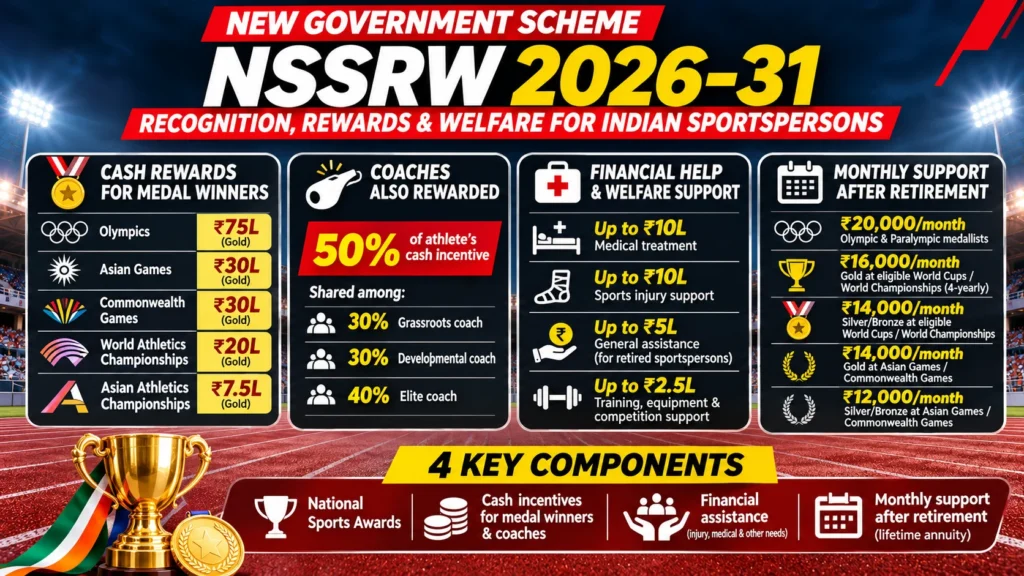
The scheme has four major components: National Sports Awards, cash incentives for international medal winners and their coaches, financial assistance for athletes and sports professionals in need, and monthly financial support for eligible sportspersons after retirement.
1. HOW MUCH MONEY WILL MEDAL-WINNING ATHLETES RECEIVE?
One of the biggest provisions is the cash incentive for Indian athletes winning medals at recognised international competitions.
Under the new guidelines, an Olympic gold medallist will receive ₹75 lakh, while silver and bronze medallists will receive ₹50 lakh and ₹30 lakh, respectively.
The rewards for major international competitions are as follows:
| Competition | Gold | Silver | Bronze |
|---|---|---|---|
| Olympic Games | ₹75 lakh | ₹50 lakh | ₹30 lakh |
| Asian Games | ₹30 lakh | ₹20 lakh | ₹10 lakh |
| Commonwealth Games | ₹30 lakh | ₹20 lakh | ₹10 lakh |
| World Athletics Championships | ₹20 lakh | ₹14 lakh | ₹8 lakh |
| Asian Athletics Championships | ₹7.5 lakh | ₹5 lakh | ₹2.5 lakh |
For Indian athletics, two competitions are specifically included in the scheme: the World Athletics Championships and the Asian Athletics Championships.
Since both are biennial competitions, the applicable reward for a gold medal is ₹20 lakh at the World Athletics Championships and ₹7.5 lakh at the Asian Athletics Championships.
The amounts are different because the government has categorised international competitions according to how frequently they are held. For example, the incentive for a biennial World Championship is 50 per cent of the amount allocated for a comparable four-yearly championship.
These figures apply to individual events at senior level. Team events are also covered, with each eligible team member, including reserve players, entitled to 75 per cent of the corresponding individual-event incentive.
However, these rewards are subject to the scheme’s participation and eligibility conditions. For most listed international championships, the number of participating countries also determines whether the full, half or one-third incentive is payable.
2. COACHES WILL ALSO RECEIVE A SHARE OF THE PRIZE MONEY
Another important feature of the new scheme is that the financial reward is not limited to athletes.
The government has introduced a provision under which the nominated coach or group of coaches can receive 50 per cent of the cash incentive payable to the medal-winning athlete.
More importantly, this amount will be divided among three levels of coaching:
Grassroots coach – 30%: The coach who initially identified and developed the athlete’s talent.
Developmental coach – 30%: The coach who further nurtured the athlete and helped develop their abilities.
Elite coach – 40%: The coach responsible for advanced training at the highest competitive level.
For example, if an athlete wins a gold medal at the World Athletics Championships and becomes eligible for ₹20 lakh, the nominated coach or coaches will collectively receive an additional ₹10 lakh.
Of this coaching incentive, ₹3 lakh will go to the grassroots coach, ₹3 lakh to the developmental coach and ₹4 lakh to the elite coach, assuming one coach is nominated in each category.
Athletes will be responsible for recommending their coaches through the online application process. They can also nominate an academy or akhara instead of individual coaches.
One important condition is that nominated coaches, academies or akharas must be registered in the authorised government database. Once the grassroots and developmental coaches are registered for a particular sport, their nominations cannot be changed.
The provision recognises that an athlete’s success is often the result of years of work involving several coaches, from the initial stages of talent identification to elite-level preparation.
3. FINANCIAL HELP FOR INJURED ATHLETES AND COACHES
Beyond medal rewards, the scheme also includes a welfare programme called the Pandit Deendayal Upadhyay National Welfare Programme for Sportspersons.
This component is designed to support athletes, coaches and sports professionals who are facing financial difficulties.
To qualify under the welfare programme, the athlete or their family must generally have an annual income of less than ₹8 lakh from all sources. Regular employees of Central or State Governments, public sector enterprises and government autonomous bodies are excluded from this assistance.
The financial support includes:
- Up to ₹10 lakh for medical treatment of eligible sportspersons.
- Up to ₹10 lakh for injuries sustained during sports training or competitions. Junior and sub-junior athletes are also covered under this provision.
- Up to ₹5 lakh in general assistance for eligible retired sportspersons.
- Up to ₹2.5 lakh for training, purchasing sports equipment and participating in recognised national and international competitions.
The scheme also extends support to coaches and sports support personnel.
Eligible coaches and support staff, including sports doctors, physiotherapists, psychologists and other professionals, can receive up to ₹2.5 lakh in general assistance and up to ₹5 lakh for medical treatment.
However, eligibility depends on their involvement in recognised national coaching camps or competitions, along with the prescribed financial conditions.
Importantly, this assistance is not automatic. Applications will be examined by a government-appointed committee, which will decide eligibility and the amount of financial support.
4. MONTHLY FINANCIAL SUPPORT AFTER RETIREMENT
Another important feature is lifetime financial assistance for eligible sportspersons who have retired from active competition.
Under this provision, eligible Indian medal winners at major international competitions can receive monthly financial assistance through an annuity.
The monthly amounts are:
| Achievement | Monthly assistance |
|---|---|
| Olympic and Paralympic medallists | ₹20,000 |
| Gold at eligible World Cups/World Championships | ₹16,000 |
| Silver/Bronze at eligible World Cups/World Championships | ₹14,000 |
| Gold at Asian Games, Commonwealth Games and Para Asian Games | ₹14,000 |
| Silver/Bronze at Asian Games, Commonwealth Games and Para Asian Games | ₹12,000 |
The assistance becomes payable when the athlete turns 30 or retires from active sport, whichever happens later. The athlete must have retired by the time of applying.
There is an important distinction for athletics. While the cash incentive component specifically recognises the biennial World Athletics Championships, the retirement assistance provision considers only World Cups or World Championships held once every four years. Therefore, a medal at the biennial World Athletics Championships does not automatically qualify an athlete for the World Championship category of this monthly assistance.
The monthly assistance is based on the athlete’s highest eligible sporting achievement and is provided for life, subject to the scheme’s conditions.
5. HOW CAN ATHLETES APPLY FOR THE BENEFITS?
For the international medal cash incentive, the athlete must submit an application through the designated online portal of the Department of Sports within six months of the conclusion of the competition.
The Ministry may waive the application requirement when sufficient information is already available to verify the athlete’s eligibility and process the payment.
The government has also made it clear that requests for relaxation will not be entertained when athletes miss the prescribed application deadline.
For welfare assistance and post-retirement financial support, eligible beneficiaries must apply through the designated government portals. Their achievements and other details may be verified through the Sports Authority of India or other authorised agencies.
The scheme also makes clear that financial assistance is subject to government approval and eligibility checks, rather than being an automatic entitlement.