




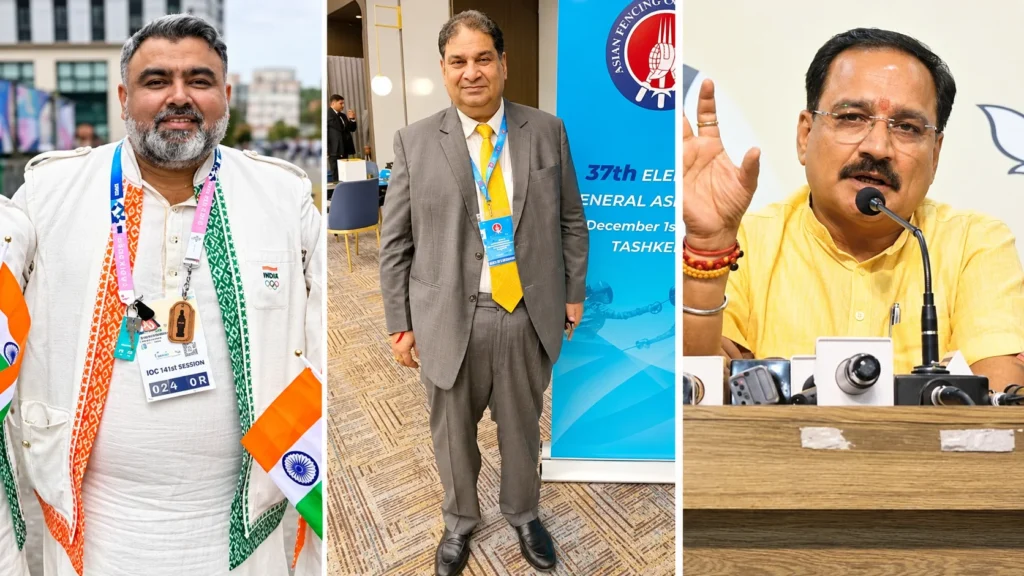
The Indian Olympic Association (IOA) is preparing for a change of leadership, with Olympic medallist Gagan Narang, former IOA secretary general Rajeev Mehta and Archery Association of India secretary general Virendra Sachdeva emerging as the three contenders for the organisation’s top position.
With incumbent president P.T. Usha not filing her nomination, the December 5, 2026 election will determine who leads Indian Olympic sport through an important four-year period.
The timing makes this election particularly significant. India is preparing to host a series of major international sporting competitions, culminating in the 2030 Commonwealth Games in Ahmedabad. The country is also looking towards strengthening its position in international sports administration and pursuing its long-term Olympic ambitions.
The three contenders bring considerably different backgrounds. Narang represents the perspective of an elite international athlete who has moved into sports administration. Mehta brings years of experience within the IOA’s administrative structure, while Sachdeva combines experience in national sports administration with a political and public-administration background.
The question is how each profile could contribute to India’s sporting ambitions.
1. GAGAN NARANG: AN OLYMPIC MEDALLIST WITH AN ATHLETE-FIRST PERSPECTIVE
Gagan Narang’s credentials begin with his achievements as an international shooter. A four-time Olympian, Narang won the bronze medal in the men’s 10m Air Rifle event at the London 2012 Olympics, giving India its first medal at those Games.
He has also won multiple medals at the Commonwealth Games, Asian Games and ISSF World Cups. His achievements earned him the Arjuna Award, Rajiv Gandhi Khel Ratna and Padma Shri.
However, his contribution to Indian sport did not end with his retirement after the Rio 2016 Olympics.
Narang established the Gagan Narang Sports Promotion Foundation and co-founded the Gun for Glory Shooting Academy, working towards creating better training opportunities for young shooters. His involvement in athlete development has given him experience beyond the competitive arena.
His administrative credentials have also grown in recent years. He was elected as an IOA vice-president in December 2022 and subsequently served as India’s Chef-de-Mission for the Paris 2024 Olympics.
The Chef-de-Mission’s responsibilities include coordinating with the organising committee and ensuring that the needs and welfare of the Indian contingent are addressed during the Games.
HOW CAN HIS PROFILE HELP INDIA?
Narang’s biggest contribution could be bringing an athlete’s perspective into the highest level of Indian sports administration.
Having experienced the Olympic environment as a competitor, he understands the demands of international competition, preparation cycles, access to sports science, recovery, equipment, coaching and the support systems required to perform at the highest level.
As president, this experience could help strengthen athlete-centred policies, improve communication between athletes and federations, and promote greater emphasis on long-term high-performance planning.
His experience as Chef-de-Mission for Paris 2024 also provides an understanding of the logistical and administrative challenges involved in managing an Indian contingent at a major international event.
With India hosting multiple international championships and the Commonwealth Games, the combination of athlete experience and Olympic administration could be particularly relevant.
However, heading the IOA involves considerably more than athlete representation. Building consensus among National Sports Federations, managing institutional responsibilities, international diplomacy and financial accountability will be equally important.
2. RAJEEV MEHTA: EXPERIENCE WITHIN THE IOA’S ADMINISTRATIVE STRUCTURE
Rajeev Mehta brings a different kind of experience to the presidential race.
He previously served as Secretary General of the Indian Olympic Association from 2014 to 2022, giving him eight years of experience within the organisation’s top administrative structure.
His involvement in Indian sports administration has extended across different federations. He has previously held positions in the Kho Kho Federation of India and Hockey India and currently serves as Secretary General of the Fencing Association of India.
His period in the IOA coincided with India’s return to the Olympic movement after the International Olympic Committee lifted the suspension of the Indian Olympic Association in February 2014.
That was a significant period for Indian Olympic administration, as the organisation had to rebuild its relationship with the international Olympic movement and operate within the governance requirements of the IOC.
Mehta’s previous experience gives him familiarity with the organisation’s functioning, its relationship with national federations and the administrative processes involved in international sporting participation.
He has also submitted a written vision document for the 2026 IOA elections.
In his election document, Mehta has outlined priorities including transparency, accountability, athlete welfare, coordination among National Sports Federations and State Olympic Associations, and stronger grassroots-to-elite sporting pathways.
He has also specifically mentioned the importance of supporting the successful hosting of the 2030 Commonwealth Games in Ahmedabad and India’s aspiration to host the 2036 Olympic and Paralympic Games.
HOW CAN HIS PROFILE HELP INDIA?
Mehta’s strongest potential contribution lies in institutional continuity and administrative experience.
Having previously occupied the Secretary General’s position, he is familiar with the IOA’s internal functioning, stakeholder relationships and the coordination required between different sporting organisations.
This experience could be useful during a period when India needs consistent communication between the IOA, the Ministry of Youth Affairs and Sports, National Sports Federations, State Olympic Associations and international sporting bodies.
His experience across multiple federations could also help in coordinating the interests of different sporting disciplines.
The important test would be translating these commitments into measurable institutional reforms, ensuring accountability and creating a professional administrative structure capable of delivering India’s growing international sporting responsibilities.
3. VIRENDRA SACHDEVA: SPORTS ADMINISTRATION WITH POLITICAL AND GOVERNMENT EXPERIENCE
Virendra Sachdeva brings a profile that is different from both Narang and Mehta.
He is the Secretary General of the Archery Association of India and has been associated with archery administration since 2008.
According to reports, Sachdeva has served in various positions within the Delhi Archery Association and the national body. His involvement has included organising archery competitions across the country and promoting the sport at the school level.
In May 2026, he was also nominated by World Archery as a member of its Commonwealth Games Committee.
The committee works towards promoting archery across Commonwealth nations, sharing expertise and resources, and supporting the sport’s inclusion in the Commonwealth Games programme.
This appointment is particularly relevant as archery is among the sports being considered for inclusion in the 2030 Commonwealth Games programme.
Beyond sports administration, Sachdeva has also served as president of the Delhi unit of the Bharatiya Janata Party (BJP), giving him experience in political organisation and public engagement.
His nomination for the IOA presidency, alongside his candidature for the male vice-president position, has placed him among the three contenders for the leadership of Indian Olympic sport.
HOW CAN HIS PROFILE HELP INDIA?
Sachdeva’s potential contribution could come from his experience in sports administration, his international engagement through archery and his background in political and public affairs.
Hosting major sporting competitions requires coordination between sports federations, government departments, state administrations, local authorities and international governing bodies.
His experience in political and organisational leadership could be relevant to facilitating such coordination, particularly as India prepares for the 2030 Commonwealth Games.
His involvement in World Archery’s Commonwealth Games Committee could also offer an understanding of how international sports federations engage with the Commonwealth Games movement and how sporting disciplines negotiate their place in major multi-sport events.
For the 2030 Games, the question of sports inclusion, athlete representation and coordination with international federations will be important.
THE BIGGEST CHALLENGE: INDIA’S INTERNATIONAL HOSTING CALENDAR
Regardless of who takes over as IOA president, the next leadership will inherit a particularly demanding international sporting calendar.
The four-year period will see India involved in several important competitions, giving the IOA an opportunity to strengthen its international sporting reputation.
2027 – ASIAN RELAYS CHAMPIONSHIPS, CHANDIGARH
India will host the Asian Relays Championships in Chandigarh in August 2027. The competition will bring leading Asian relay teams to India and provide an opportunity to strengthen the country’s athletics event-management capabilities.
2028 – ASIAN INDOOR ATHLETICS CHAMPIONSHIPS, ODISHA
Bhubaneswar is scheduled to host the Asian Indoor Athletics Championships in 2028. The competition will be an important continental event and a valuable opportunity to prepare for the global indoor championship later in the year.
2028 – WORLD ATHLETICS INDOOR CHAMPIONSHIPS, ODISHA
World Athletics has awarded the 2028 World Indoor Championships to Odisha. Hosting a global championship will require close coordination with World Athletics, the Athletics Federation of India, the state government and the organising authorities.
2029 – ASIAN ATHLETICS CHAMPIONSHIPS, CHENNAI
Chennai has been selected to host the 2029 Asian Athletics Championships, subject to financial and other government guarantees. The event would bring another major continental athletics competition to Indian soil.
2030 – COMMONWEALTH GAMES, AHMEDABAD
The biggest assignment of the period will be the centenary edition of the Commonwealth Games in Ahmedabad. India has officially secured the hosting rights, making the event a major milestone in the country’s sporting ambitions.
The IOA’s responsibility will extend beyond the competition itself. It will need to coordinate with Commonwealth Sport, the Indian government, the host state, the organising committee and National Sports Federations while ensuring that Indian athletes receive adequate preparation and support.
These championships also offer an opportunity to develop experienced event-management professionals, improve sporting infrastructure, strengthen international relationships and create facilities that continue to benefit Indian athletes after the competitions conclude.
Apart from these factors, decoding who will emerge as the next IOA president is a tough task. In this election, 60 votes will come from members representing the 30 eligible National Sports Federations, eight from State Olympic Associations (SOMs), two from athlete representatives and one from the IOC member, taking the total to 71 votes. Whoever secures the highest number of votes will become the next IOA president.
Several media reports have suggested Gagan Narang as the front-runner for the top post. He has also filed only one nomination for the presidency, indicating that he is confident and is following a ‘president or nothing’ approach.
Rajeev Mehta, on the other hand, has filed his nomination for president in two sets, with four members backing him through two different sets of proposers and seconders, demonstrating his support base.