





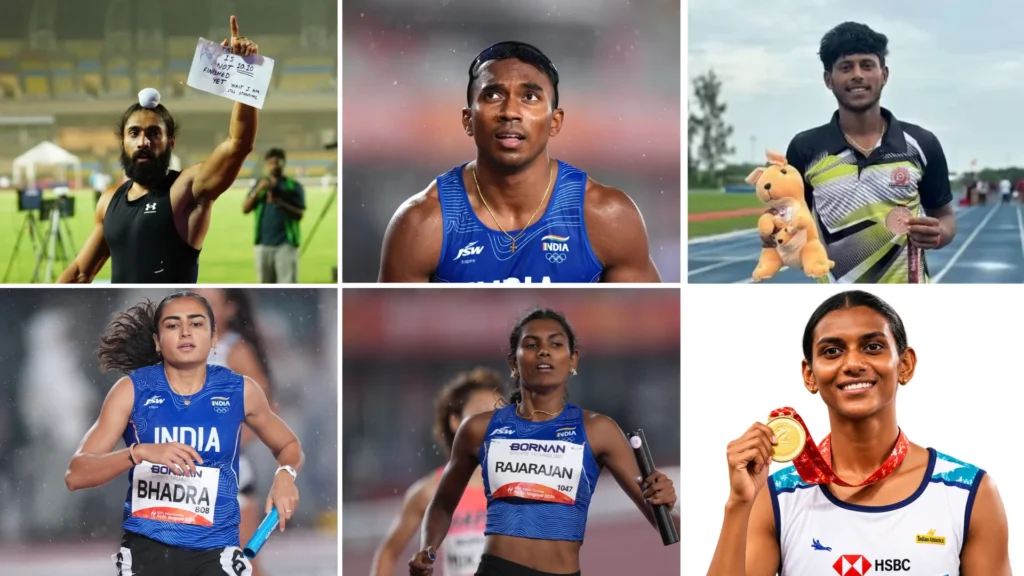
Indian sprinting enjoyed a statistically impressive 2026 season, headlined by the men’s 100m national record dipping to 10.09 seconds and the women’s pack closing in on the long-standing national mark.
Yet, beneath the celebratory headlines of domestic milestones lies a sobering reality. Nearly 80 years after independence, Indian sprinting remains starved of global and continental relevance. While athletes continue to push their limits, the broader ecosystem – spanning the Athletics Federation of India (AFI), High-Performance Centres (HPCs), corporate backers like Reliance, and the coaching apparatus – has yet to translate domestic speed into international podiums.
Men’s 100m: Gurindervir breaches 10.10s, but sub-10 remains elusive
On paper, 2026 was a landmark year for men’s sprinting. At the 29th National Senior Athletics Federation Competition in Ranchi in May, the national record fell three times in 48 hours. Gurindervir Singh first edged past Animesh Kujur’s previous mark of 10.18s with a 10.17s run in the semifinals, only for Animesh to immediately reclaim it with 10.15s. In the final, Gurindervir settled the duel in emphatic fashion, storming to 10.09s to become the first Indian to dip below the 10.10-second barrier.
Animesh proved his mettle later in the season, clocking 10.14s in Wetzlar, Germany, in July – a rare bright spot-on foreign soil.
2026 Men’s 100m top performers:
- Gurindervir Singh: 10.09s
- Animesh Kujur: 10.14s
- Tamilarasu: 10.23s
Compared to 2025’s best of 10.18s, India’s top timing improved by 0.09 seconds. However, context tempers the celebration. India is still floundering outside the sub-10 club – a benchmark that has become the bare minimum for global competitiveness. Worse still, almost all of these breakthrough timings have come in familiar home conditions. When tested abroad under the intense pressure of the Commonwealth Games or Asian Games, Indian sprinters routinely falter. India’s last Asian Games medals in the men’ 100m and 200m came way back in 1978 in Bangkok, courtesy of Ramaswamy Gnanasekaran – a 48-year drought that defines logic.
Women’s 100m: Harita Bhadra closes in on national record
The women’s 100m saw a similar surge in domestic depth, led by Harita Bhadra. Opening her season at 11.55s, Harita showed steady progression before clocking a blistering 11.22s at the Indian Athletics Final Series in New Delhi on September 10. That run made her the second-fastest Indian woman in history, bringing her within 0.05 seconds of Dutee Chand’s 2021 national record of 11.17s.
Abinaya Rajarajan (11.31s) and Giridharani Ravikumar (11.35s) also peaked at the New Delhi meet, ensuring that all three of India’s top performers in 2026 beat 2025’s season-best mark of 11.36s (set by Dhanalakshmi Sekar).
2026 women’s 100m top performers:
- Harita Bhadra: 11.22s
- Abinaya Rajarajan: 11.31s
- Giridharani Ravikumar: 11.35s
Despite the 0.14-second year-on-year improvement at the top, Dutee Chand’s five-year-old record survived, and the women’s times, much like the men’s, remain heavily reliant on domestic tracks.
100M SEASON COMPARISON: 2025 VS 2026
| Category | 2025 Best | 2026 Best | Improvement |
|---|---|---|---|
| Men’s 100m | 10.18s | 10.09s | -0.09s |
| Women’s 100m | 11.36s | 11.22s | -0.14s |
Asian and World perspective: The widening chasm
While India celebrates incremental hundredths of a second at home, the rest of the world is sprinting away at a much faster clip.
In Asia, the men’s 100m has already moved firmly into the sub-10 era, highlighted by Thailand’s Puripol Boonson clocking 9.90 seconds in 2026. Globally, the world-leading mark stood at 9.84 seconds, leaving Gurindervir 0.25 seconds behind, an eternity in the 100m dash. On the women’s side, the global standard sat at 10.63 seconds in 2026, exposing a massive 0.59-second chasm between the world’s elite and India’s best.
Ultimately, 2026 exposed a familiar, uncomfortable truth about Indian track and field. In any corporate setup, decades of heavy investment without meaningful returns on the global stage would be deemed an abject failure and trigger an immediate leadership overhaul. Yet in Indian athletics, generation after generation of sprinters push their bodies to the limit, break domestic records, and eventually retire while the administrators, federations, and high-performance managers stay firmly entrenched without accountability. Until Indian sprinters are routinely tested and forged in high-stakes international meets rather than sheltered in domestic circuits, breaking national records will remain a hollow victory.
Read more
- Gurindervir snatches 100m national record from Animesh in stunning race
- In 10.09 seconds, Gurindervir Singh flies to where no Indian sprinter ever has
- How Harita Bhadra became India’s second-fastest woman
- India’s fastest woman praises the next fastest: Dutee Chand backs Harita Bhadra
- Asian Games 2026: Harita Bhadra sprints to women’s 200m bronze
- Boonson and Chen sprint to Asian Games records in Nagoya
- Athletics: list of Indian national record holders