





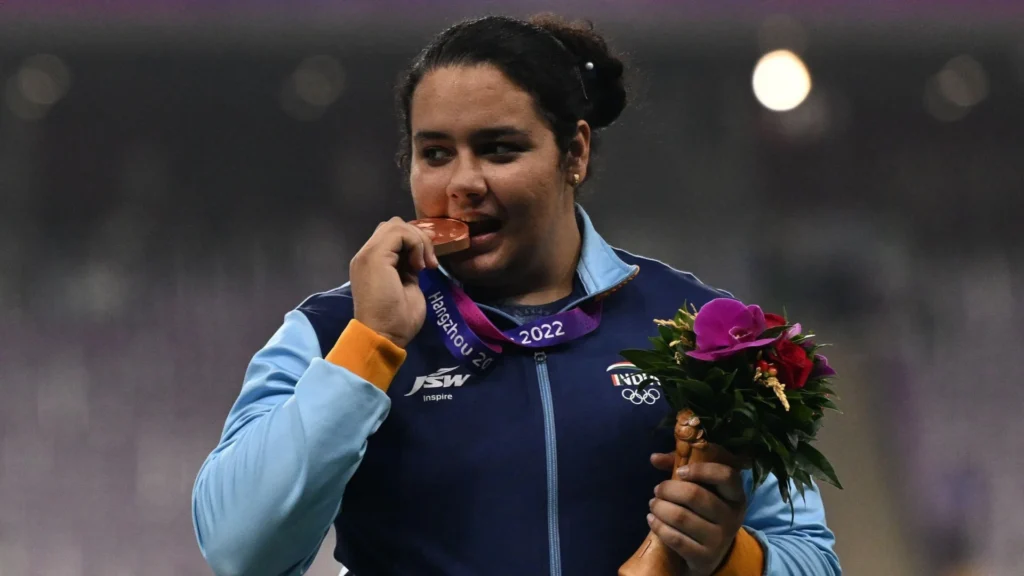
India’s Asian Games bronze medallist Kiran Baliyan has been handed an eight-year ban by the National Anti-Doping Agency (NADA) for anti-doping rule violations. The suspension has been backdated to July 4, 2024, and will remain in force until July 3, 2032.
The decision is a major setback for Indian athletics. Baliyan was one of India’s leading female shot put athletes and had created history by winning a bronze medal at the 2022 Asian Games, held in Hangzhou in 2023.
However, this is not a case involving only a positive doping test. There is another important allegation involving the handling of her urine sample and alleged interference with the doping-control process.
Her case also reached the Delhi High Court in December 2025, where she challenged the disciplinary panel’s refusal to allow her to examine important witnesses.
So, what exactly happened? Which banned substance was found in her sample? What was her defence? And most importantly, why did she receive eight years instead of the usual four-year doping ban?
Let’s understand the complete case
Kiran Baliyan came into the national spotlight after winning the bronze medal in the women’s shot put at the 2022 Asian Games in Hangzhou, China.
Her throw of 17.36 metres helped her secure the bronze medal on September 29, 2023.
She became the first Indian woman in 72 years to win an Asian Games medal in women’s shot put.
Baliyan had also won gold at the 2023 National Inter-State Athletics Championships and silver at the 2024 Federation Cup.
However, her career came under serious scrutiny in 2024 after an adverse doping test.
The case dates back to July 2024.
Baliyan tested positive for a prohibited substance called Metandienone, also known as Methandienone.
Following the adverse analytical finding, NADA provisionally suspended her in September 2024.
NADA’s subsequent list of provisionally suspended athletes identified three provisions against Baliyan: Articles 2.1, 2.2 and 2.5. The substance mentioned was Metandienone.
Baliyan’s reported eight-year suspension involves three provisions of the National Anti-Doping Agency Anti-Doping Rules, 2021.
Let’s understand what each one means.
Article 2.1 – Presence of a prohibited substance
This is one of the most common anti-doping violations.
It means that a prohibited substance, or its metabolites or markers, has been detected in an athlete’s sample.
In Baliyan’s case, the substance identified in the reported findings was Metandienone.
Article 2.2 – Use or attempted use of a prohibited substance
Article 2.2 deals with the use or attempted use of a prohibited substance or prohibited method.
Article 2.5 – Tampering or attempted tampering with doping control
This is the particularly important part of Baliyan’s case.
Article 2.5 deals with tampering or attempted tampering with any part of the doping-control process.
In simple language, it concerns interference with the process used to collect, handle, examine or manage an athlete’s doping sample.
This is treated as a separate and serious anti-doping violation.
Because an ordinary positive doping case and a case involving both a positive test and an additional tampering violation can result in very different punishments.
The tampering allegation is one of the main reasons why the reported suspension is eight years rather than four.
Controversy surrounding her urine sample?
This is one of the most important parts of the entire case.
During the proceedings, Baliyan challenged the allegations and presented her version of what happened during sample collection.
According to her submission before the Delhi High Court, she had inadvertently touched the urine sample container while washing her hands.
She maintained that:
- The contact with the container was accidental.
- She immediately informed the Doping Control Officer (DCO) about the incident.
- She voluntarily provided a fresh urine sample without delay.
This became important because NADA was also pursuing an allegation under Article 2.5, which concerns tampering or attempted tampering.
Baliyan wanted to establish exactly what happened during the sample-collection process and whether the prescribed procedures had been properly followed.
During the anti-doping proceedings, Baliyan filed an application before the Anti-Doping Disciplinary Panel (ADDP).
She requested permission to summon and examine certain witnesses, including the Doping Control Officers involved in the collection and handling of her samples.
Why did she want these witnesses?
Her argument was that their statements could help establish whether the sample-collection procedure had been followed correctly.
She particularly wanted to examine two important issues:
First: Compliance with testing procedures
She wanted to establish whether the officials had followed the applicable International Standards for Testing and Investigation while collecting her sample.
Second: Chain of custody
Chain of custody is a very important concept in doping cases.
In simple language, it means maintaining a proper record of how a sample was collected, sealed, handled, transported and delivered for testing.
It helps establish that the sample tested by the laboratory was the same sample originally collected from the athlete and that its integrity was maintained throughout the process.
Baliyan argued that examining the concerned officers was necessary to clarify these issues and defend herself against the allegations.
However, on November 25, 2025, the Anti-Doping Disciplinary Panel rejected her application, holding that it was not maintainable.
She subsequently challenged this decision before the Delhi High Court.
On December 9, 2025, the Delhi High Court passed an order in Kiran Baliyan vs National Anti-Doping Agency and Others.
The matter was heard by Justice Sachin Datta.
The Court examined her argument that she should be allowed to summon and question witnesses during the anti-doping proceedings.
Her lawyers referred to Rule 13.2.2.2.8 of the NADA Anti-Doping Rules, 2021.
This provision recognises a party’s right to present relevant evidence, make written and oral submissions, and call and examine witnesses.
The lawyers also referred to the World Anti-Doping Code’s International Standard for Results Management, which recognises similar rights for athletes during hearings.
After considering the arguments, the High Court observed that athletes appearing before the disciplinary panel had also been given opportunities to produce witnesses in other cases.
The Court considered it unfair to deny Baliyan the same opportunity.
Consequently, the High Court:
- Set aside the disciplinary panel’s November 25, 2025 order rejecting her witness application.
- Allowed her to file a fresh application before the disciplinary panel.
- Directed the panel to consider her request in light of the Court’s observations.
- Directed that final arguments should wait until the witness application was considered and the relevant evidence was recorded.
An important clarification: The Delhi High Court did not declare Baliyan innocent, nor did it cancel the doping allegations. It only addressed her right to present evidence and examine witnesses.
The actual merits of the doping allegations were not decided by this order.
Why was the punishment increased to eight years instead of four?
This is probably the biggest question surrounding the case.
Under normal circumstances, a first anti-doping violation involving a non-specified prohibited substance can attract a four-year suspension.
The NADA rules also provide a standard four-year suspension for a violation of Article 2.5, which deals with tampering.
But there is an important provision that explains how these two punishments can be combined.
It is Article 10.9.3.3 of the NADA Anti-Doping Rules, 2021.
This rule states that when NADA establishes an Article 2.5 violation in connection with the doping-control process for an underlying anti-doping violation, the tampering violation is treated as a separate first violation.
More importantly, the punishment for tampering must be served consecutively rather than concurrently with the punishment for the underlying doping violation.
Suppose an athlete receives two separate four-year suspensions:
| Violation | Standard punishment |
|---|---|
| Presence/use of a non-specified prohibited substance (Articles 2.1/2.2) | 4 years |
| Tampering with the doping-control process (Article 2.5) | 4 years |
| Total, if served consecutively | 8 years |
What does consecutively mean?
It means one punishment starts after the other, rather than both punishments running together.
- If both four-year punishments ran simultaneously, the athlete would serve only four calendar years.
- If they ran consecutively, the athlete would serve four years plus another four years, making eight years.