




“Yes, it is very sad. It has been almost 24 years, and I am yet to receive a sports award. I have applied many times, including in 2017 and 2018. I have also requested the Dhyan Chand or Arjuna Award, but I am still waiting.”
Those words belong to Anuradha Biswal—a five-time national champion, Asian Athletics Championships bronze medallist, and the woman whose national record in the 100m hurdles stood untouched for nearly two decades.
Her quiet grief captures a jarring asymmetry in Indian sport. Today, a streamlined system rightly ensures that modern stars receive the Arjuna Award within a couple of years of their breakthrough achievements—as Jyothi Yarraji did in 2024, two years after breaking Biswal’s long-standing mark. Yet for the trailblazers who laid the foundation when tracks were slower, funding was scarce, and institutional backing was almost non-existent, national recognition has functioned less like an automatic salute to excellence and more like an exhausting bureaucratic marathon.
On the track and in the field, glory is measured in fractions of a second, centimetres, and metres. When it comes to official gratitude, however, the clock has often run into decades.
Consider veteran quarter-miler Sucha Singh, whose wait lasted more than half a century. A towering figure in Indian athletics throughout the 1970s, Singh represented India at two Asian Games and the Asian Athletics Championships. He clinched silver in the men’s 4x400m relay and bronze in the individual 400m at the 1970 Bangkok Asian Games, before adding another relay silver at the 1974 Tehran Asian Games. In 1975, he stood atop the podium with gold in the men’s 4x400m relay at the Asian Athletics Championships in Seoul.
Despite this glittering haul, national honour eluded him. According to a January 2025 report by The Tribune, Sucha Singh first applied for the Arjuna Award in 1980 and persisted every year until 1990. Repeatedly overlooked, he eventually stopped applying, having lost all hope of ever receiving the recognition.
His agonising wait finally ended when he was selected for the Arjuna Award (Lifetime) for 2024—receiving the honour on January 17, 2025, at the age of 74.
Speaking to NNIS Sports, Sucha Singh said, “It came late, but it felt really good to finally receive the award.”
While Sucha Singh finally had his moment in the sun, several other trailblazers—Asian Games champions, Olympians, and Commonwealth medallists—remain trapped in the shadows of official indifference.
The Medallists Still Waiting for Their Due
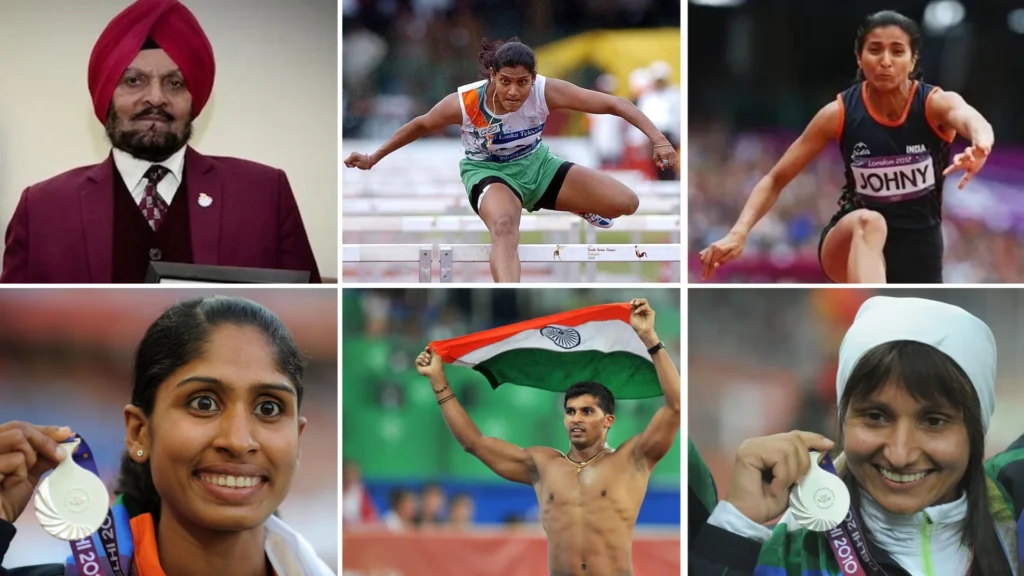
1. Balkar Singh — An Asian Games Gold Medallist
Long before Indian athletics commanded widespread international attention, Balkar Singh was one of the nation’s premier field-event athletes. At the 1958 Asian Games in Tokyo, he captured gold in the men’s discus throw with a mark of 47.66m. Eight years later, he returned to the continental podium, winning bronze at the 1966 Bangkok Asian Games with a throw of 47.64m. Two Asian Games medals, including a coveted gold, cement his place in Indian sporting lore—yet his career stands as a stark reminder of how easily earlier generations have been left behind when national honours are handed out.
2. Anuradha Biswal — A Pioneer of Indian Women’s Hurdles
Anuradha Biswal was a driving force behind the rise of women’s hurdling in India. A five-time national champion and an Asian Athletics Championships bronze medallist, she etched her name into the record books in 2002 with a personal best of 13.38 seconds in the women’s 100m hurdles. That national record stood unbroken for nearly 20 years until Jyothi Yarraji clocked 13.23 seconds in 2022—a feat that helped earn Jyothi the Arjuna Award in 2024. Yet the woman who set the benchmark for two decades is still waiting.
Speaking to NNIS Sports, she said, “Yes, it is very sad. It has been almost 24 years, and I am yet to receive a sports award. I have applied many times, including in 2017 and 2018. I have also requested the Dhyan Chand or Arjuna Award, but I am still waiting.”
She also recalled a poignant interaction with cricket icon Sachin Tendulkar in Odisha: “Once, Sachin Tendulkar visited Odisha and was sitting with hockey legend Dilip Tirkey. I was also there. When Sachin heard that I had been competing for nearly 25 years, even after pregnancy, he was surprised and said that he had played for 23 years,” she added.
3. Mayookha Johny — From Asian Gold to the World Championships Final
Mayookha Johny achieved feats in horizontal jumps that remain rare in Indian track and field history—she is still the only Indian female triple jumper to breach the 14m barrier. At the 2011 Asian Athletics Championships in Kobe, Japan, she struck gold in the women’s long jump with a leap of 6.56m. That very same year, she reached the final of the World Athletics Championships in Daegu, South Korea, finishing eighth in the women’s long jump with 6.37m. Her international resume also boasts a gold and a silver medal at the Asian Indoor Athletics Championships, alongside towering personal bests of 6.64m in the long jump and 14.11m in the triple jump. Despite conquering Asia and reaching a World Championships final, Mayookha has yet to receive any National Awards or recognition.
4. Maliakkal Prajusha — Commonwealth Games Silver Medallist
Another pillar of Indian women’s horizontal jumps, Maliakkal Prajusha delivered one of the standout moments of the 2010 Commonwealth Games in New Delhi, capturing silver in the women’s long jump with a leap of 6.47m. She also earned a bronze medal at the Asian Indoor Athletics Championships and represented India across major international arenas, including the Asian Games, recording a career-best jump of 6.55m in June 2010. Yet, years after standing on the Commonwealth podium on home soil, she remains without any National Awards or formal sports recognition.
5. Kashinath Naik — A Commonwealth Games Javelin Medallist
Years before Indian javelin became a global powerhouse, Kashinath Naik was laying the groundwork on the international stage. At the 2010 Commonwealth Games, he threw 74.29m to claim a historic bronze medal in the men’s javelin throw. Armed with a personal best of 77.33m set in 2009, Naik also represented India at the Asian Games and the Asian Athletics Championships, consistently securing top-eight finishes against Asia’s best. Despite winning a Commonwealth medal for the country, he is yet to receive any National Awards or sports recognition.
6. Harwant Kaur — Two Olympics and a Commonwealth Games Silver
Few Indian throwers matched the longevity and pedigree of Harwant Kaur during the 2000s. After winning silver at the 2002 Asian Athletics Championships and posting a formidable personal best of 63.05m in 2004, she represented India at two Olympic Games—Athens 2004 and Beijing 2008. She also won a bronze medal at the Asian Athletics Championships before delivering one of her career’s defining performances at the 2010 Commonwealth Games in New Delhi, winning silver in the women’s discus throw with 60.16m. Despite being a two-time Olympian, Asian Championships medallist, and Commonwealth silver medallist, Harwant Kaur has yet to receive any National Awards or official recognition.
Beyond Trophies: Why Recognition Cannot Wait
For champions like Balkar Singh, Harwant Kaur, and Mayookha Johny, this is about far more than a plaque or a ceremonial title. It is about dignity, institutional memory, and acknowledging a lifetime of sacrifice in service to Indian sport.
Medals are etched into almanacs, and national records live on in statistics—but national honours exist to tell future generations whose shoulders they stand upon. Celebrating today’s winners within a couple of years is progress; leaving yesterday’s pioneers to age in obscurity is a failure of conscience.
It is time for the Ministry of Youth Affairs and Sports, the Athletics Federation of India (AFI), and selection committees to proactively audit and honour these overlooked legends—without forcing septuagenarians and retired champions to beg for their due through endless paperwork. Share their stories, amplify their names, and demand that India’s forgotten icons receive their rightful place in history while they are still here to witness it.