





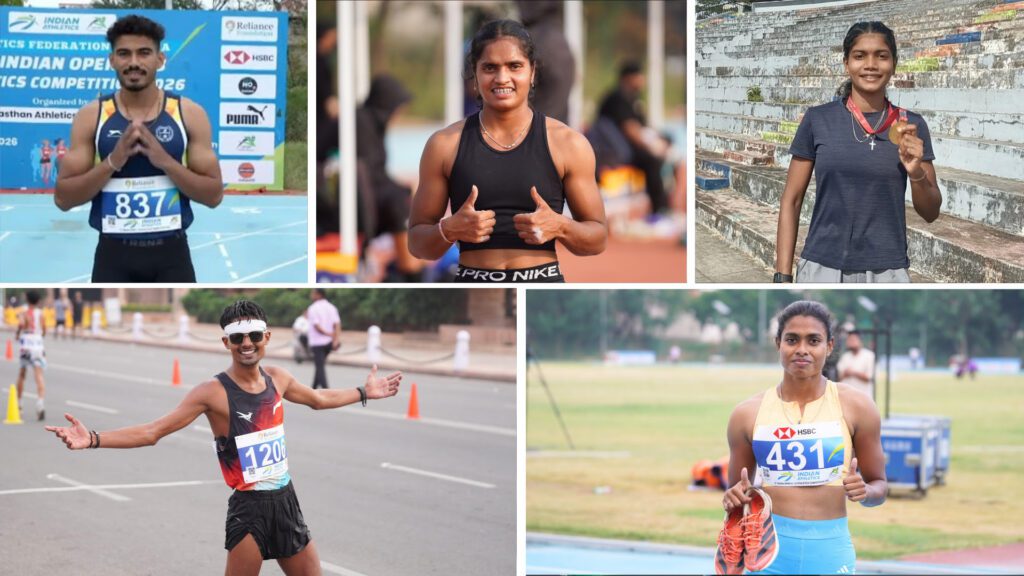
The 6th National U23 Athletics Championships concluded at Jaipur’s Sawai Mansingh Stadium on 18 October 2026 after three days of competition involving almost 1,500 athletes. While the long season appeared to affect performances in several events, the championships also revealed a group of promising athletes capable of making their mark in senior athletics over the next one to two years.
From a record-breaking sprint performance to personal bests in the long jump, pole vault and heptathlon, the competition offered encouraging signs for India’s next generation. Race walking also produced a promising prospect in the men’s half marathon, where a young athlete won the title on his first attempt at the distance.
Here are five breakout performers from the U23 Nationals who could be worth following as they progress towards the senior ranks.
1. Rushiprashad (Maharashtra): The Sprinter Who Broke the 10.30-Second Barrier
At 21, Maharashtra’s Rushiprashad emerged as one of the most exciting sprint prospects at the championships. He won the men’s 100m title in 10.29 seconds (+0.7m/s), setting a new meet record and surpassing the previous mark of 10.38 seconds set by Animesh Kujur in 2024.
The performance also marked Rushiprashad’s first time under 10.30 seconds. According to the supplied rankings, the result places him joint 10th on India’s all-time men’s 100m list.
Breaking the 10.30-second barrier represents an important milestone for a young sprinter. However, the next challenge will be to reproduce that speed consistently and continue improving against senior-level competition.
Rushiprashad now has an encouraging foundation to build on. At 21, he has time to develop his acceleration, maximum speed and race execution as he targets higher-level competitions.
The quality of his coaching and training environment will be important in determining how far he progresses. If he can build on this performance, he could become a name to watch in Indian sprinting over the next few seasons.
2. Sheeba D. (Kerala): A Long Jump Breakthrough Beyond Six Metres
Kerala’s Sheeba D. delivered a significant breakthrough in the women’s long jump, winning the U23 title with a personal best of 6.29m.
The 21-year-old’s winning mark was particularly important because it was her first legal jump beyond six metres. Earlier in the season, she had recorded a wind-assisted 6.19m, but her performance in Jaipur provided a new benchmark under legal conditions.
Her 6.29m effort also placed her joint seventh among Indian women’s long jumpers for the 2026 season, alongside Kusuma Ravada, according to the supplied rankings.
The result puts Sheeba among the emerging athletes to follow in an event that has produced several accomplished Indian jumpers. Kerala has a strong tradition in the discipline, with athletes such as Anju Bobby George, Ancy Sojan and Nayna James helping raise its profile.
Sheeba will now look to build on her U23 success and translate her progress into consistent performances at senior competitions. Repeated jumps beyond six metres would be an important next step, while further improvements could strengthen her position among India’s leading long jumpers.
Her performance in Jaipur suggests that she has taken a meaningful step forward. The challenge now is to make that breakthrough the starting point for further progress.
3. Nitika Akare (Madhya Pradesh): Pole Vault Record and a Bigger Ambition
Madhya Pradesh’s Nitika Akare produced one of the standout field-event performances of the championships, winning the women’s pole vault with a lifetime best of 4.15m.
The 20-year-old also established a new meet record, confirming her progress in an event where improvements of even a few centimetres can make a significant difference.
Her clearance of 4.15m placed her joint fourth among Indian women’s pole vaulters, alongside Pavithra Venkatesan and Vazhalipilli Sureshbabu Sureka, based on the supplied rankings. It also brought her closer to the national record of 4.26m.
Nitika’s progress is particularly encouraging because she opened her 2026 season with a clearance of 3.70m. Her improvement to 4.15m represents a gain of 45 centimetres over the season, highlighting the progress she has made.
She trains at the DSYW Academy under coach Ghanshyam Yadav, alongside men’s pole vault national record holder Dev Meena and former record holder Kuldeep Yadav. Training in an environment with accomplished pole vaulters gives her opportunities to learn from athletes who have already reached the highest levels of the event in India.
Nitika explained how the event has evolved in the country.
“Women’s pole vault has improved a lot in India. Earlier, national medal-winning heights were around 3.60m and 3.70m, but now you have to clear at least 4m to win a medal,” she said.
She also recalled watching Dev Meena break the national record and wondering when she would achieve similar milestones.
“I always used to watch Dev Meena breaking the national record and think, ‘When will I be able to set national records and meet records like him?’ Now, the performances have started, and there is more to come,” she said.
Her next objective will be to turn her meet-record performance into a platform for further progress. With the national record within reach of her current best, Nitika has a clear target as she prepares to move towards senior competition.
4. Nitin Gupta (Uttar Pradesh): From Junior Race Walking to the Senior Challenge
Uttar Pradesh’s Nitin Gupta emerged as a promising endurance prospect after winning the men’s half marathon race walk in 1:29:00 at the U23 Nationals.
The performance was notable because it was his first attempt at the distance. At 18, Nitin is still developing physically and technically, yet he has already demonstrated an ability to compete across different race-walking distances.
He holds India’s U20 5,000m race walk national record of 18:54.37. The supplied rankings also place that performance as the fourth-fastest ever recorded by a U20 walker.
Nitin has continued to progress over longer distances this season. He has beaten senior competitors at the Indian Race Walking Championships and Indian Athletics Series-9, suggesting that he is beginning to make the transition beyond junior competition.
His coach, Basant Rana, said Nitin had performed well in the junior category over the past two seasons.
The U23 Nationals, however, also highlighted the physical demands of a long athletics season. Nitin acknowledged that fatigue affected him during the competition.
“This was the last competition. I had fatigue due to long season,” he said.
Despite that fatigue, his focus has already shifted towards the next stage of his career.
“Don’t worry, next season’s target is the senior category,” he added.
That ambition will now need to be supported by continued development, recovery and experience over longer distances. Race walking places considerable demands on endurance, pacing and technique, so a successful transition will depend on his ability to maintain those qualities as the competitive level rises.
Nevertheless, his U20 record, progress over 10,000m and victory in the half marathon race walk make him one of the young athletes worth monitoring.
5. Bidisha Kundu (West Bengal): A Record-Breaking Heptathlon Performance
West Bengal’s Bidisha Kundu completed the five-athlete shortlist with an impressive performance in the women’s heptathlon, winning the title with a personal best of 5,260 points.
The 21-year-old also established a new meet record and crossed the 5,000-point barrier for the first time.
The heptathlon demands versatility across seven events: the 100m hurdles, high jump, shot put, 200m, long jump, javelin throw and 800m. Athletes must balance speed, strength, jumping ability and endurance, making improvements across multiple disciplines particularly valuable.
Bidisha recorded lifetime bests in five of the seven events during her championship campaign.
Her results were:
- 100m hurdles: 14.09s — PB
- High jump: 1.69m
- Shot put: 9.53m
- 200m: 24.65s — PB
- Long jump: 5.88m — PB
- Javelin throw: 26.40m — PB
- 800m: 2:20.83 — PB
Her overall score reflects progress across several disciplines rather than reliance on a single outstanding event. That breadth is important in combined events, where every improvement can contribute to a higher total.
Bidisha has been training under Rudra Pratim Roy, a multi-event specialist who previously worked as a strength and conditioning coach with East Bengal’s football team.
Roy believes she still has considerable room to improve. He also highlighted how recently she began focusing on the heptathlon.
“She has only been doing the heptathlon for three years. Before this, she won an individual U20 gold in the high jump,” he said.
The javelin remains one area for improvement. In the heptathlon, athletes can gain valuable points by developing their throwing technique, and Roy plans to bring in a throwing specialist to help Bidisha improve in that event.
Her potential also connects her to West Bengal’s history in combined events. The state has produced several accomplished heptathletes, including Olympian Soma Biswas.
Bidisha is aware of that legacy and hopes to continue the tradition.
“Many heptathletes have come from West Bengal, and some have even gone to the Olympics. Soma Biswas, for example, was trained by my coach’s father,” she said.
Reflecting on her competition in Jaipur, Bidisha identified both the events that went well and those where she wanted more.
“I came prepared for the hurdles and was expecting a better performance in the 200m. In the 800m, I was only aiming to break the meet record,” the 21-year-old added.
Her 5,260-point performance provides a strong foundation for the next stage of her development. If she can improve her weaker events while maintaining progress in her stronger disciplines, she could become a more competitive contender in the senior heptathlon.
What Comes Next for India’s U23 Breakout Athletes?
The performances at Jaipur’s Sawai Mansingh Stadium offered five different examples of how young Indian athletes are progressing towards senior competition.
Rushiprashad broke through the 10.30-second barrier in the 100m. Sheeba D. crossed six metres legally for the first time. Nitika Akare raised her pole vault personal best to 4.15m. Nitin Gupta demonstrated his potential over longer race-walking distances, while Bidisha Kundu surpassed 5,000 points in the heptathlon.
Their next steps will differ. Sprinters and jumpers must turn promising individual performances into consistent results, while race walkers need to build endurance and experience. For combined-event athletes, improvement across several disciplines will be essential.
The U23 category offers a valuable bridge between junior success and senior competition. However, progress is rarely linear, and these performances alone cannot guarantee future national titles or international selection.
What they do provide is evidence of development, a clearer picture of each athlete’s strengths and specific targets for the seasons ahead.
For Indian athletics, the value of the U23 Nationals lies not only in the medals won but also in identifying athletes who could strengthen the senior ranks in the coming years. Rushiprashad, Sheeba D., Nitika Akare, Nitin Gupta and Bidisha Kundu all left Jaipur with performances that give them reasons to aim higher.
The next one to two years will show how successfully they can build on these breakthroughs and establish themselves among India’s senior athletes.